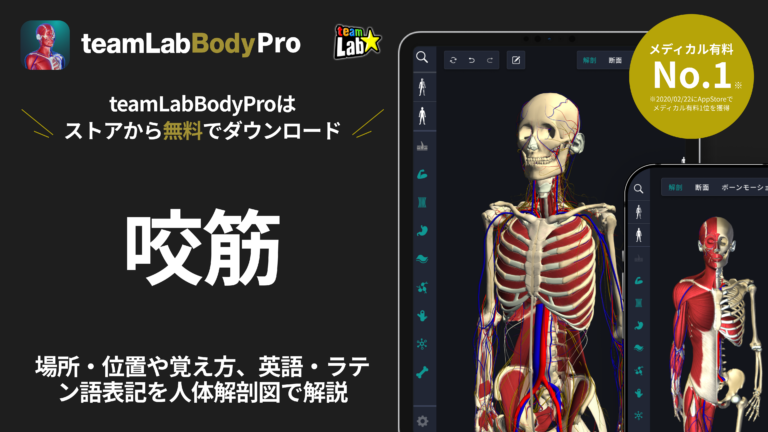
Temporalis muscle: origin, insertion, function and nerve
Introduction
This article first introduces specialist knowledge about one part of the body in human anatomy, then explains effective ways to study.
In human anatomy it is not enough to memorize the names of organs, muscles and bones; you also have to remember where in the body they are. That is why you need to learn as efficiently as possible.
I hope that reading this article and using the app will deepen your understanding, even a little.
This time we explain the temporalis muscle and how to study human anatomy.
Download teamLabBody Pro for free
A 3D anatomy app that shows every structure of the human body
Download teamLabBody Pro here!

What is the temporalis muscle?
In the anatomy app you can view a selection of anatomical 3D models. Each model can be viewed in several ways: the surface, cross-sections, the nervous system and more. This time we explain using the anatomy app.
About the temporalis

The temporalis is a large muscle spread over the side of the skull and one of the muscles of mastication.
It arises from the temporal lines, along the border between the parietal and temporal bones, and the temporal fossa, passes under the zygomatic arch toward the jaw and inserts on the coronoid process of the mandible.
The temporalis is made of long fibres layered on one another, and their contraction gives a powerful bite. In particular it closes the jaw and controls sideways movement, helping to grind food efficiently.
It is supplied by the deep temporal nerves from the third division of the trigeminal nerve (mandibular nerve) and is essential for the function and stability of the jaw. Remember that all the muscles of mastication are supplied by the trigeminal nerve, not by the facial nerve that supplies the muscles of facial expression. The anterior fibres of the temporalis run vertically and lift the mandible; the posterior fibres run almost horizontally and pull it back.
Learning points
1. Use visual material: with detailed anatomical figures or 3D models, understand the exact position and structure of the temporalis. Follow its course from the origin (temporal lines) to the insertion (coronoid process of the mandible) and see how it relates to the other muscles of mastication and to the jaw joint.
2. Palpation: touch the side of your head to feel where the temporalis is. Open and close your mouth and move your jaw from side to side to feel the muscle contract and relax; clenching your teeth makes the movement especially clear.
3. Observe movement: watch your jaw in a mirror to understand how the temporalis is involved, and watch other people too. Look closely at the movements while eating and talking to get a feel for its work.
4. Understand the function: learn concretely how the temporalis contributes to chewing and to the stability of the jaw, how biting force is produced and how the jaw joint is kept stable.
5. Compare with related muscles: the muscles of mastication are the temporalis, masseter, medial pterygoid and lateral pterygoid. Sort them by action: the temporalis, masseter and medial pterygoid close the mouth, while the lateral pterygoid opens it and moves the mandible forward. Hide the zygomatic arch in 3D to see the temporalis passing inside the arch to the coronoid process.
How to study human anatomy
Here are concrete study methods using a human anatomy app.
Check your learning history and practice repeatedly
These are the steps for checking your anatomy learning history and reviewing effectively.
1. Check your learning history in the app
Checking your study history in the app is an important step for making effective progress in anatomy. First open the app and go to the history section from the main menu. Many anatomy apps show your progress in graphs or lists, so you can see which parts you have studied and how much time you spent on each.
With that data you can see where you are strong and where you need to invest more time and effort. It also helps to mark the parts you find difficult or need to relearn with tags or notes. Checking your history regularly and going back over what you have already studied leads to effective review and deeper understanding.
2. Make a review plan
Making an efficient review plan based on your learning history is extremely effective for consolidating knowledge. First identify your weak points and what you need to relearn. Then spread those topics over a weekly or monthly calendar and create a concrete study schedule. Working to a plan lets you cover every region evenly and prevents you from cramming too much information at once.
It is also effective to set study reminders with a task management app or a digital calendar. It is important to review your progress regularly and stay flexible enough to adjust the plan when necessary. Studying with goals and a plan lets you acquire anatomical knowledge efficiently.
3. Learn visually with the 3D functions
With the 3D functions, anatomy becomes much easier to understand visually. The 3D model shows the structure of the body in three dimensions and lets you observe each part in detail. You can grasp intuitively the positional relationships of deep muscles and organs that are hard to see in a flat figure. For example, you can rotate a specific muscle or bone and zoom in and out to study it down to the finest detail.
Many apps can also display cross-sections of each part on the 3D model, which helps you understand the internal structure. This variety of visual information helps you remember and improves your responsiveness in exams and in practice. Learning visually in 3D gives you deeper, more efficient anatomical knowledge.
Make use of the memo function
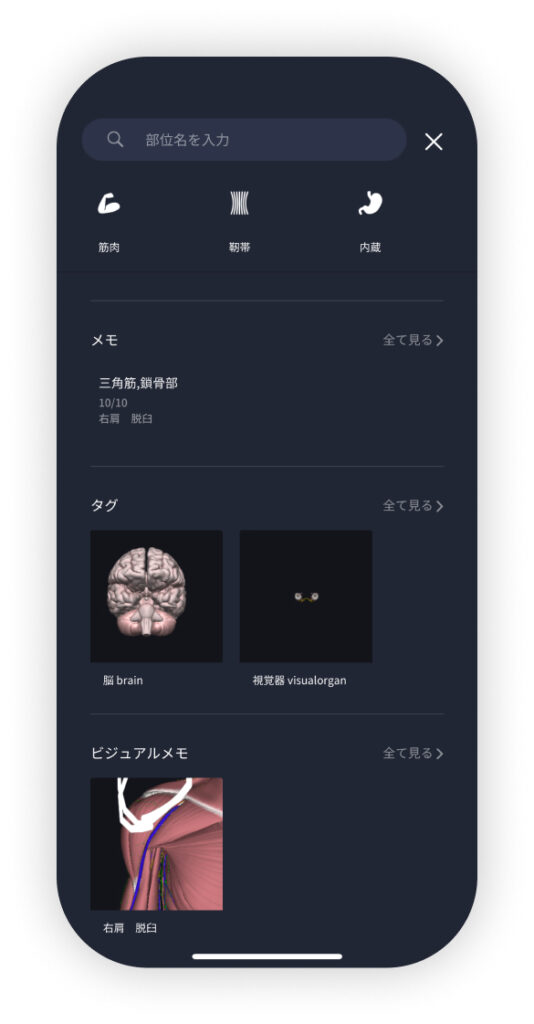
Make notes of what you notice and the key points while studying so that you do not forget them. The memo function lets you type text, save images or write by hand, depending on your needs. Tag your memos so that you can find them easily later.
Test what you have learned regularly in quiz form
Regularly testing what you have learned in quiz form is a very effective way to consolidate anatomical knowledge. Quizzes let you repeat the material while objectively checking how well you understand it and where the gaps are.
For example, taking quizzes in a study app at set intervals lets you recheck what you have learned and reinforce your memory. There are many quiz formats (multiple choice, fill in the blank, short answer), and each helps you understand from a different angle and use different kinds of knowledge.
Get feedback
If possible, get feedback from other learners or specialists. It helps you find what you have not understood and what you can improve. Testing yourself regularly also helps you stay motivated: feeling your achievements and progress makes you want to keep learning.
Summary
This time we explained how to study the "temporalis muscle" with an app!
Thank you for reading this far.
I hope this article helps you with your study of anatomy.
Learning is a long road with no end, but I sincerely wish you success. Let's keep learning together and work toward the exam!
Look forward to the next article.
Download teamLabBody Pro for free
A 3D anatomy app that shows every structure of the human body
Download teamLabBody Pro here!