Nasopharynx: location, structure, auditory tube and soft palate
Introduction
This article first introduces specialist knowledge about one part of the body in human anatomy, then explains effective ways to study.
In human anatomy it is not enough to memorize the names of organs, muscles and bones; you also have to remember where in the body they are. That is why you need to learn as efficiently as possible.
I hope that reading this article and using the app will deepen your understanding, even a little.
This time we explain the nasopharynx and how to study human anatomy.
Download teamLabBody Pro for free
A 3D anatomy app that shows every structure of the human body
Download teamLabBody Pro here!

What is the nasopharynx?
In the anatomy app you can view a selection of anatomical 3D models. Each model can be viewed in several ways: the surface, cross-sections, the nervous system and more. This time we explain using the anatomy app.
About the nasopharynx
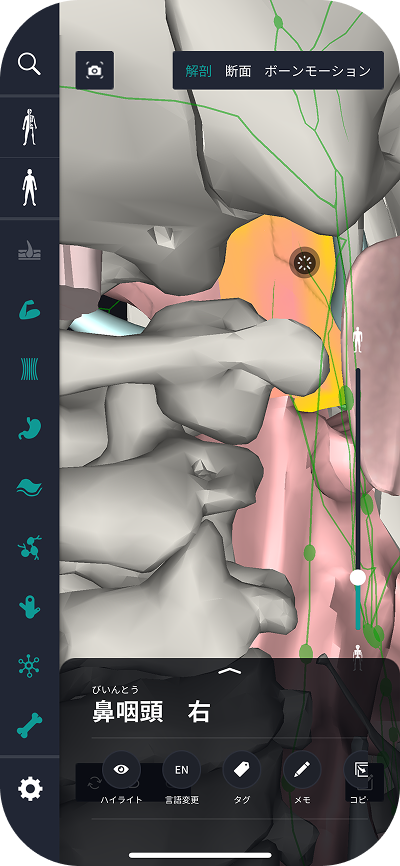
The nasopharynx is the uppermost part of the pharynx, lying behind the nasal cavity and above the soft palate. In front it opens into the nasal cavity through the choanae, above it touches the base of the skull (the body of the sphenoid and the occipital bone), and below, at the level of the soft palate, it continues into the oropharynx. As part of the respiratory system it serves as a passage for air; in addition, the pharyngeal opening of the auditory tube (Eustachian tube) opens on its lateral wall, linking it to the middle ear and giving it an important role in equalizing the air pressure in the tympanic cavity. It is an important region through which air breathed in through the nose passes.
The nasopharynx also contains tissue involved in immunity: on its posterosuperior wall lies the pharyngeal tonsil (adenoid). Together with the palatine and lingual tonsils, the pharyngeal tonsil forms a ring of lymphoid tissue called Waldeyer's ring, which defends against pathogens from outside at the place where air and food entering through the nose and mouth first make contact. The pharyngeal tonsil is largest in childhood and becomes smaller after puberty.
Learning points
Anatomical understanding: structure of the nasopharynx and its relations
In front, the nasopharynx connects with the nasal cavity through the choanae, and below, at the level of the soft palate, it continues into the oropharynx. The pharyngeal opening of the auditory tube opens on its lateral wall, through which pressure is equalized with the middle ear. Above and behind this opening is a bulge formed by the tubal cartilage (torus tubarius), and further back is a deep recess called the pharyngeal recess. The pharyngeal tonsil lies on the posterosuperior wall of the nasopharynx and has an immune function. When studying the anatomy, it is important to understand how these structures are arranged and how they work together.
A 3D anatomy app or an anatomical model is useful for study. With them you can actually see the nasopharynx and its surrounding structures (the auditory tube and adenoid) and gain a deeper understanding. Using illustrations of the head and neck to understand how the nasopharynx connects with other structures also makes your study more effective.
Functional understanding: role and function of the nasopharynx
The nasopharynx plays an important role in breathing, equalizing ear pressure, immunity and speech. When studying, you need to understand how these functions are linked. For example, it is important to consider the role of the auditory tube in keeping the air pressure in the tympanic cavity equal to the outside air, the flow of air in nasal breathing, and the nasopharynx's influence on the resonance of the vocal tract in speech. The auditory tube is normally closed and opens when the tensor veli palatini contracts during swallowing or yawning. This mechanism is why swallowing helps when your ears feel blocked during an aeroplane's take-off or landing, or in a lift.
Consciously feeling the pressure relationships between the nasal cavity, mouth and ears while you actually breathe deepens your functional understanding. Paying attention to the sensation of using the nasal cavity when you speak will also help you understand the role of the nasopharynx through your own body.
Applying the positional relations: movement of the soft palate and closure of the nasopharynx
The relationship with the soft palate is essential for understanding the nasopharynx. When you swallow food or make sounds such as "pa" or "ba", the soft palate rises and presses against the posterior wall of the pharynx, closing off the nasopharynx from the oropharynx. This is called velopharyngeal closure; it stops food from flowing back into the nose and keeps the voice from escaping through the nose. For nasal sounds such as "n" or "ma", on the other hand, the soft palate lowers and the voice passes from the nasopharynx into the nasal cavity, where it resonates. Display a midsagittal section of the head in 3D and locate the soft palate, nasopharynx, oropharynx and pharyngeal opening of the auditory tube; then say "pa" and "ma" yourself and feel the difference in how the sound passes through the nose. This lets you understand the role of the nasopharynx through your own body.
How to study human anatomy
Here are concrete study methods using a human anatomy app.
Check your learning history and practice repeatedly
These are the steps for checking your anatomy learning history and reviewing effectively.
1. Check your learning history in the app
Checking your study history in the app is an important step for making effective progress in anatomy. First open the app and go to the history section from the main menu. Many anatomy apps show your progress in graphs or lists, so you can see which parts you have studied and how much time you spent on each.
With that data you can see where you are strong and where you need to invest more time and effort. It also helps to mark the parts you find difficult or need to relearn with tags or notes. Checking your history regularly and going back over what you have already studied leads to effective review and deeper understanding.
2. Make a review plan
Making an efficient review plan based on your learning history is extremely effective for consolidating knowledge. First identify your weak points and what you need to relearn. Then spread those topics over a weekly or monthly calendar and create a concrete study schedule. Working to a plan lets you cover every region evenly and prevents you from cramming too much information at once.
It is also effective to set study reminders with a task management app or a digital calendar. It is important to review your progress regularly and stay flexible enough to adjust the plan when necessary. Studying with goals and a plan lets you acquire anatomical knowledge efficiently.
3. Learn visually with the 3D functions
With the 3D functions, anatomy becomes much easier to understand visually. The 3D model shows the structure of the body in three dimensions and lets you observe each part in detail. You can grasp intuitively the positional relationships of deep muscles and organs that are hard to see in a flat figure. For example, you can rotate a specific muscle or bone and zoom in and out to study it down to the finest detail.
Many apps can also display cross-sections of each part on the 3D model, which helps you understand the internal structure. This variety of visual information helps you remember and improves your responsiveness in exams and in practice. Learning visually in 3D gives you deeper, more efficient anatomical knowledge.
Make use of the memo function

Make notes of what you notice and the key points while studying so that you do not forget them. The memo function lets you type text, save images or write by hand, depending on your needs. Tag your memos so that you can find them easily later.
Test what you have learned regularly in quiz form
Regularly testing what you have learned in quiz form is a very effective way to consolidate anatomical knowledge. Quizzes let you repeat the material while objectively checking how well you understand it and where the gaps are.
For example, taking quizzes in a study app at set intervals lets you recheck what you have learned and reinforce your memory. There are many quiz formats (multiple choice, fill in the blank, short answer), and each helps you understand from a different angle and use different kinds of knowledge.
Get feedback
If possible, get feedback from other learners or specialists. It helps you find what you have not understood and what you can improve. Testing yourself regularly also helps you stay motivated: feeling your achievements and progress makes you want to keep learning.
Summary
This time we explained how to study the "nasopharynx" with an app!
Thank you for reading this far.
I hope this article helps you with your study of anatomy.
Learning is a long road with no end, but I sincerely wish you success. Let's keep learning together and work toward the exam!
Look forward to the next article.
Download teamLabBody Pro for free
A 3D anatomy app that shows every structure of the human body
Download teamLabBody Pro here!