Interosseous membrane of the forearm: position and role
- Introduction
- What is the interosseous membrane of the forearm?
- How to read the name of the interosseous membrane of the forearm
- Features of the interosseous membrane of the forearm
- Where the interosseous membrane of the forearm is
- How to remember the interosseous membrane of the forearm
- The interosseous membrane of the forearm in English and Latin
- Fun facts about the interosseous membrane of the forearm
- Structures related to the interosseous membrane of the forearm: features of the radius
- Structures related to the interosseous membrane of the forearm: where the radius is
- Structures related to the interosseous membrane of the forearm: fun facts about the radius
- Quiz and answers on the interosseous membrane of the forearm
- Summary
Introduction
In this article we explain the interosseous membrane of the forearm in detail.
The interosseous membrane of the forearm is a strong membrane stretched between the radius and the ulna. It joins the two bones of the forearm and is an important structure for spreading the forces that come from the hand. It keeps the two bones at the right distance while still allowing pronation and supination, and it also gives origin to the deep muscles of the forearm. In this article we cover how its Japanese name is read, its features, where it is, how to remember it, its English and Latin names, and the anatomy of the related radius. Use this article to deepen your understanding of the body.
Watch the video about the interosseous membrane of the forearm here (in Japanese)
Download teamLabBody Pro for free
A 3D anatomy app that shows every structure of the human body
Download teamLabBody Pro here!

What is the interosseous membrane of the forearm?
The interosseous membrane of the forearm is an important piece of connective tissue in the forearm that joins the radius and the ulna. It keeps the two bones apart while allowing pronation and supination, and it passes forces that reach the radius from the wrist on to the ulna, which makes the forearm more stable.
How to read the name of the interosseous membrane of the forearm
In Japanese, the interosseous membrane of the forearm (前腕骨間膜) is read zenwan kokkanmaku: zenwan means forearm and kokkanmaku means interosseous membrane. It is a membrane between bones and one of the elements that support how the forearm works.
Features of the interosseous membrane of the forearm
Anatomical illustrations show that the interosseous membrane of the forearm is elastic yet very strong. It plays an especially important role in rotating the forearm and in transmitting force.
Where the interosseous membrane of the forearm is
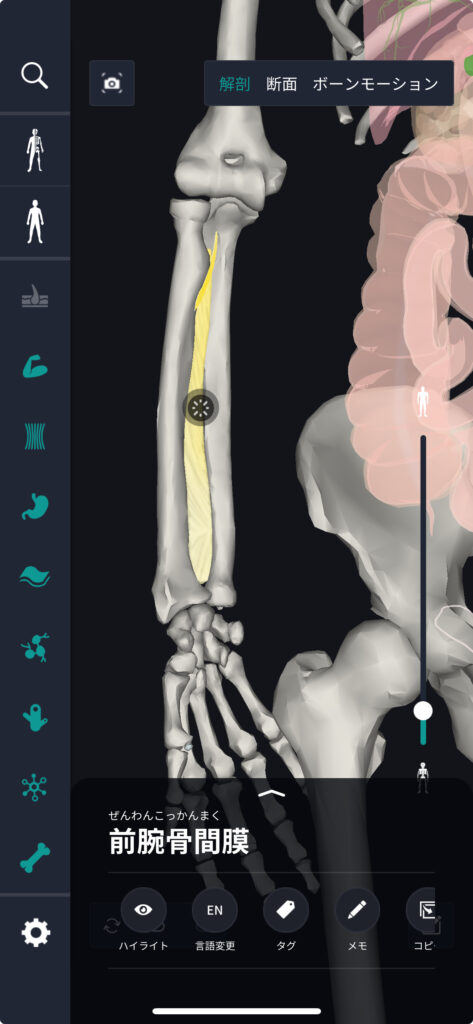
The interosseous membrane of the forearm lies between the radius and the ulna and joins the two bones. Anatomical illustrations let you see its exact position.
How to remember the interosseous membrane of the forearm
An easy way to remember it is the phrase “the membrane in the middle of the forearm that joins the radius and the ulna”. This phrase brings back both its position and its function.
The interosseous membrane of the forearm in English and Latin
In English it is called the “Interosseous Membrane of the Forearm”, and in Latin “Membrana interossea antebrachii”.
Fun facts about the interosseous membrane of the forearm
The fibres of the interosseous membrane run obliquely downward and medially from the radius to the ulna. Thanks to this direction, when you put your weight on your hand, the force that reaches the radius from the wrist is passed through the membrane to the ulna and then spread to the humerus at the elbow. The flexor pollicis longus, flexor digitorum profundus and pronator quadratus arise from the front of the membrane, and deep extensors such as the abductor pollicis longus and extensor pollicis brevis arise from the back, so the membrane also acts as a partition dividing the forearm into front and back.
Structures related to the interosseous membrane of the forearm: features of the radius
The radius is one of the two main bones of the forearm and lies on the thumb side (laterally). One of its most notable features is that its lower end connects to the wrist, so it contributes a great deal to wrist movement.
Its length and shape also make the radius the main element in rotating the forearm. In relation to the interosseous membrane, the radius is joined to the ulna through this membrane, which makes the forearm more stable and functional.
Structures related to the interosseous membrane of the forearm: where the radius is
The radius lies on the lateral, or thumb, side of the forearm and continues toward the wrist. At the top it connects with the humerus and the ulna through the head of the radius near the elbow; at the bottom it forms the radiocarpal joint with the scaphoid and lunate at the wrist. Importantly, the radius is the bone that turns around the ulna during pronation and supination, and it plays a major part in wrist movement as well.
The position of the interosseous membrane between the radius and the ulna also shows how it supports the coordinated movement of the two bones.
Structures related to the interosseous membrane of the forearm: fun facts about the radius
An interesting point about the radius is that it is the only forearm bone that takes part directly in the wrist joint; the ulna is kept away from the carpal bones by an articular disc. Forces coming from the hand are first received by the radius and then spread to the ulna through the interosseous membrane. Near the upper end of the membrane there is a small ligament called the oblique cord, whose fibres run in the opposite direction to those of the membrane, a point that often comes up in exams.
The relationship between the radius and the interosseous membrane is also essential for a stable forearm and efficient transmission of force, and it supports our movements in daily life and in sport.
Quiz and answers on the interosseous membrane of the forearm
Q1. Which two bones does the interosseous membrane of the forearm join?
A: The radius and the ulna.
Summary
This time we explained where the interosseous membrane of the forearm is, how to remember it, and its English and Latin names.
What did you think?
I hope this article has deepened your understanding of anatomy.
Learning is a long road with no end, but I sincerely wish you success. Let's keep learning together and work toward the exam!
Look forward to the next article.
Learn more with the anatomy app "teamLabBody Pro"!
teamLabBody Pro is a 3D human anatomy app that covers the whole body: muscles, organs, nerves, bones and joints.
The human body is faithfully reproduced from CT and MRI data of multiple subjects. Textbook-level content supervised by doctors can be viewed freely from any angle, so the app can be used in many medical settings, such as explaining surgery to patients or studying anatomy as a student.
If you would like to see the parts introduced this time in more detail, download the anatomy app "teamLabBody Pro".
Download teamLabBody Pro for free
A 3D anatomy app that shows every structure of the human body
Download teamLabBody Pro here!