beginning
In this article, I will explain effective study methods, starting with knowledge of specialized parts in human anatomy.
In human anatomy, it is necessary not only to memorize the names of various organs, muscles, and bones, but also to remember where they are located in the body. Therefore, it is necessary to learn as efficiently as possible.
I hope you can read this article and use the app to deepen your understanding even a little bit.
Now, I'll explain the details about the “popliteal muscle” and how to study human anatomy.
teamLab Body Pro Free Download
A 3D anatomy app that shows all the structures of the human body
Download teamLab Body Pro here!
What are popliteal muscles?
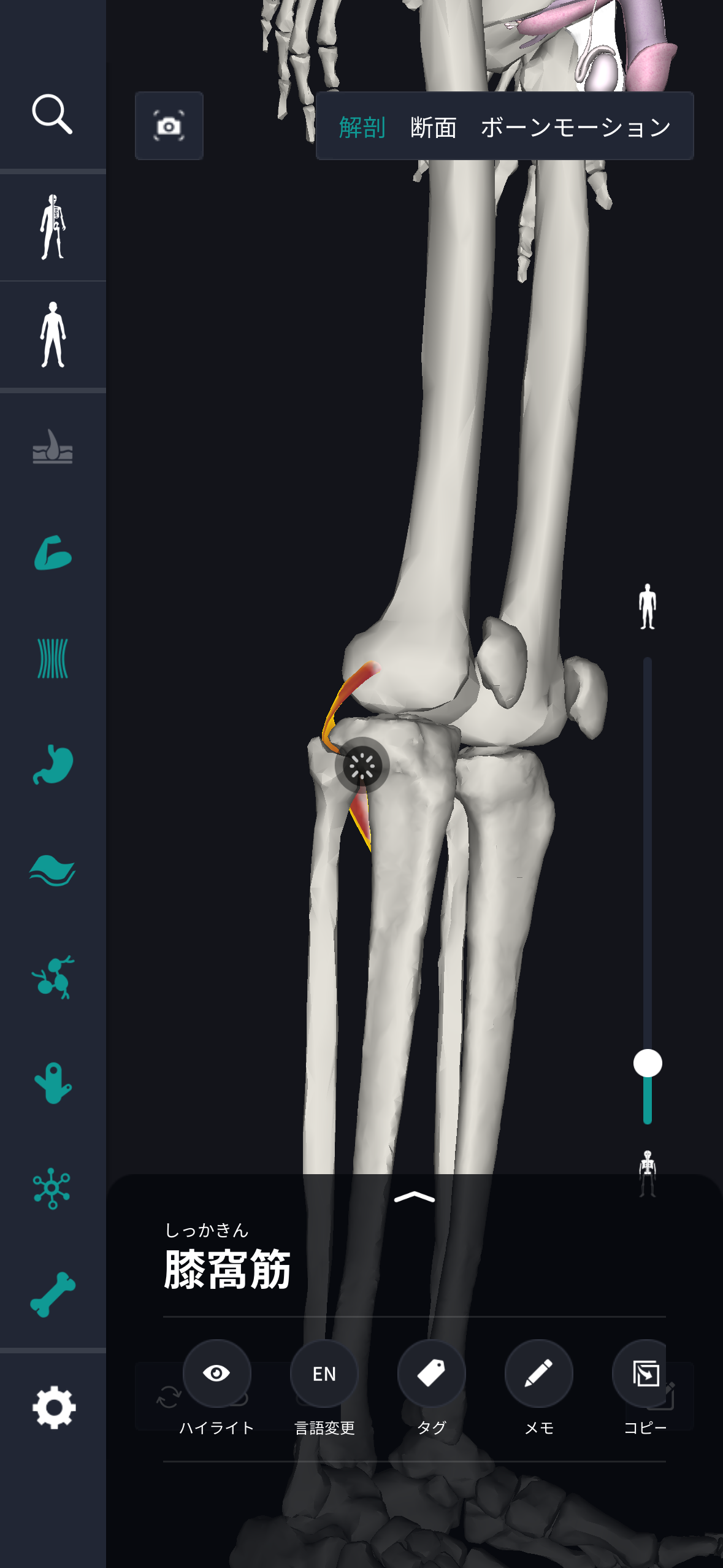
In the anatomy application, you can view a selection of anatomy 3D models. In this model, there are various observation methods such as surfaces, cross-sections, and nervous systems. This time, I'll explain using an anatomy application.
About popliteus muscle
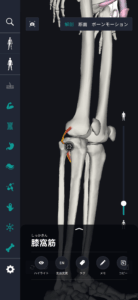
Study points
Location and structure of popliteal muscle
The popliteus muscle is located on the back side of the knee joint and is one of the important muscles involved in many movements that move the body. This muscle attaches to the outside of the femur, which is the posterior bone of the thigh, and connects to the upper inner side of the tibia, which is the shin bone. Due to this position, the popliteus muscle contributes to knee stability, and plays an important role, especially when bending the knee from an extended state. The popliteus muscle is a relatively small muscle, but its structure is elaborate and works in cooperation with other muscles and tissues. Muscles are formed by bundling muscle fibers, and these bundles are further covered by connective tissue called fascia. Due to this structure, the popliteal muscle is strong, flexible, and enables smooth movement. It also coordinates with surrounding muscles, such as the thoracic muscles and hamstrings, so that various movements of the knee joint can be performed smoothly. This includes stabilizing the knee when walking, moving up and down slopes, and sudden changes of direction in sports. The function of the popliteal muscle plays an active role in everyday movements without knowing it. The role played by its position and structure is the foundation for healthy movement of the entire lower limb. For smooth movement in daily life and exercise, the flexibility and strength of this muscle itself is one key point.
The role and function of the popliteal muscle
The popliteus muscle is a muscle that plays an important role in daily life and sports, and is involved in knee movement and stability. The main function of this muscle is to support the smooth movement of the knee joint. The popliteus muscle is particularly active when bending the knee. For example, it helps to naturally bend and stretch the knee during movements such as standing up from a sitting position or climbing stairs. Also, the popliteus muscle is involved in the rotational movement of the knee joint, and has the role of rotating the shin in an appropriate direction while stabilizing the thigh. This helps the knee joint move in the correct trajectory when walking or driving, and works to protect the joint from abnormal movements. Since the popliteus muscle affects the smoothness and accuracy of foot movements, it also contributes greatly to sports performance. In sports where sudden changes of direction and jumps are repeated during games, the flexibility and stability of this muscle is key to preventing injuries. Furthermore, since it is located behind the knee, it is essential for maintaining posture, and provides a sense of stability even when in a static position. By working properly, the popliteal muscles can be expected to reduce the burden on the knee during prolonged standing work or movement, and reduce fatigue. Thus, although inconspicuous, the popliteal muscle plays an important role and provides essential elements for healthy daily movement.
English notation for popliteal muscle
The English name for popliteus muscle is “popliteus muscle.” This name indicates a specific muscle located on the back side of the knee, and is commonly used in English-speaking countries. The word “popliteus” is derived from the Latin word “poples,” which refers to the back of the knee. These names derived from Latin are widely used in the fields of medicine and anatomy, and play a role as an academic lingua franca. This muscle has an important role even though it is small, and the term “popliteus muscle” is also used in English to explain its function and position. For example, in anatomy classes and textbooks, when learning the anatomy of the back of the knee, you learn about this muscle called the poplitheus muscle. Also, when reading English medical papers and materials, it is easier to understand research and information about the knee if you know the term popliteus muscle. Thus, the English notation for popliteal muscle is essential knowledge even in international communication. Therefore, knowing the name of this muscle is also useful for health management and exercise guidance around the knee. In particular, there are many situations where understanding based on the term popliteus muscle is required when referring to overseas fitness information or when interacting at international sporting events. In this way, grasping the English notation for popliteal muscle leads to an improvement in knowledge in many fields.
How to study human anatomy
I will explain specific study methods using human anatomy applications.
Check your past learning history and practice repeatedly
Here are the steps to check your anatomy learning history and practice iteratively effectively.
1. Check your learning history in the app
Reviewing your learning history with the application is an important step in effectively advancing anatomy learning. First, launch the app and go to the learning history section from the main menu. Many anatomy apps are designed to show your progress in the form of graphs and lists, so you can visually check which parts you've learned about and how much time you've spent.
By using this data, you can understand which areas you have strengths in and where you need to spend more time and effort. We also recommend using a dedicated tag or notebook function to mark areas you are particularly weak at or where you need to relearn. Regularly checking your learning history and looking back on past learning content will lead to efficient review and deepening understanding.
2.Make a plan for iterative learning
Making an efficient repetitive learning plan based on learning history is extremely effective in promoting knowledge retention. First, identify weak points and areas where you need to relearn. Next, arrange these study items into a weekly or monthly calendar and create a specific study schedule. By proceeding in a planned manner, you can learn each part evenly and avoid packing in a large amount of information at once.
Using a task management app or digital calendar to set study reminders is effective. Also, it's important to have the flexibility to regularly review progress and revise plans as needed. By having goals and proceeding with your studies in a planned manner, you can efficiently acquire anatomical knowledge.
3.Use 3D features to learn visually
By utilizing the 3D function, learning anatomy is easier to understand visually. The 3D model shows the structure of the human body three-dimensionally, and each part can be observed in detail. This makes it possible to intuitively grasp positional relationships between deep muscles and organs that are difficult to capture in a planar view. For example, you can learn even the smallest details by rotating specific muscles and bones and zooming in and out.
Also, there are many apps that have the function of displaying cross-sectional views of each part using a 3D model, which is useful for deepening understanding of internal structures. This diversity of visual information helps with memory retention and improves immediate responsiveness in tests and practice situations. By utilizing the 3D function and learning visually, you can learn anatomy knowledge more deeply and efficiently.
Use the memo function concretely
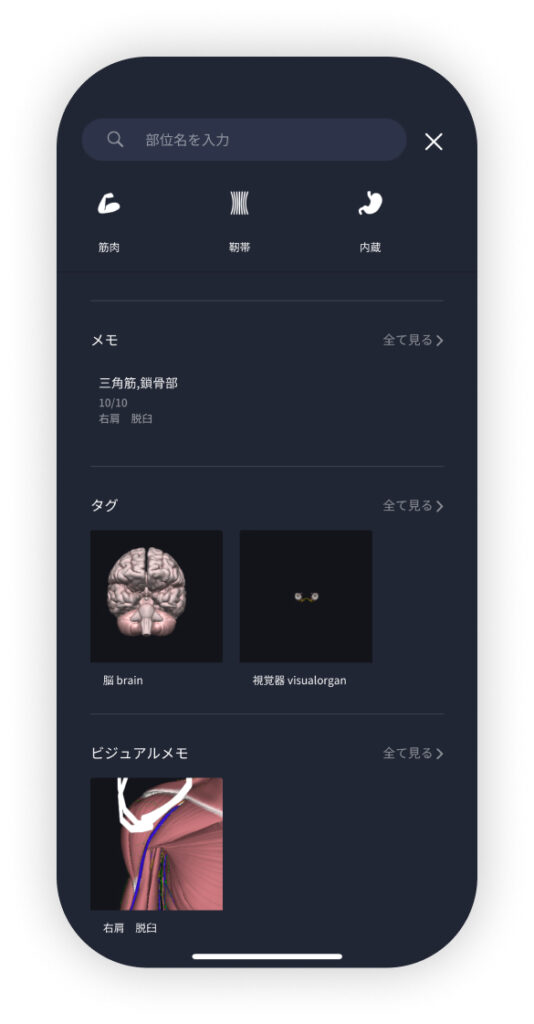
Test your learning regularly in the form of quizzes
Regularly testing what you've learned in a quiz format is a very effective way to anchor your anatomy knowledge. Quiz-style tests help you objectively grasp your level of understanding and areas you lack while repeating knowledge.
For example, by using a learning app to conduct quizzes every specific period, you can reconfirm what you've learned and strengthen your memory. There are a wide range of quiz formats, such as multiple choice questions, fill-in-the-blank questions, and short answer questions, and each helps understanding from a different angle and develops the ability to utilize various types of knowledge.
Get feedback
If possible, get feedback from other learners and experts. It helps you find your own gaps in understanding and areas for improvement. You can also keep yourself motivated to learn by regularly testing yourself. Feeling a sense of accomplishment and progress increases motivation for continuous learning.
summary
This time, I explained how to study “popliteal muscles” using an application!
Thank you for reading this far.
I would be happy if reading this article helped you learn about anatomy.
Learning is a long, never-ending journey, but I sincerely wish you all the best. Let's continue to study together and work hard for the national exam!
Please look forward to the next blog.