beginning
In this article, I will explain effective study methods, starting with knowledge of specialized parts in human anatomy.
In human anatomy, it is necessary not only to memorize the names of various organs, muscles, and bones, but also to remember where they are located in the body. Therefore, it is necessary to learn as efficiently as possible.
I hope you can read this article and use the app to deepen your understanding even a little bit.
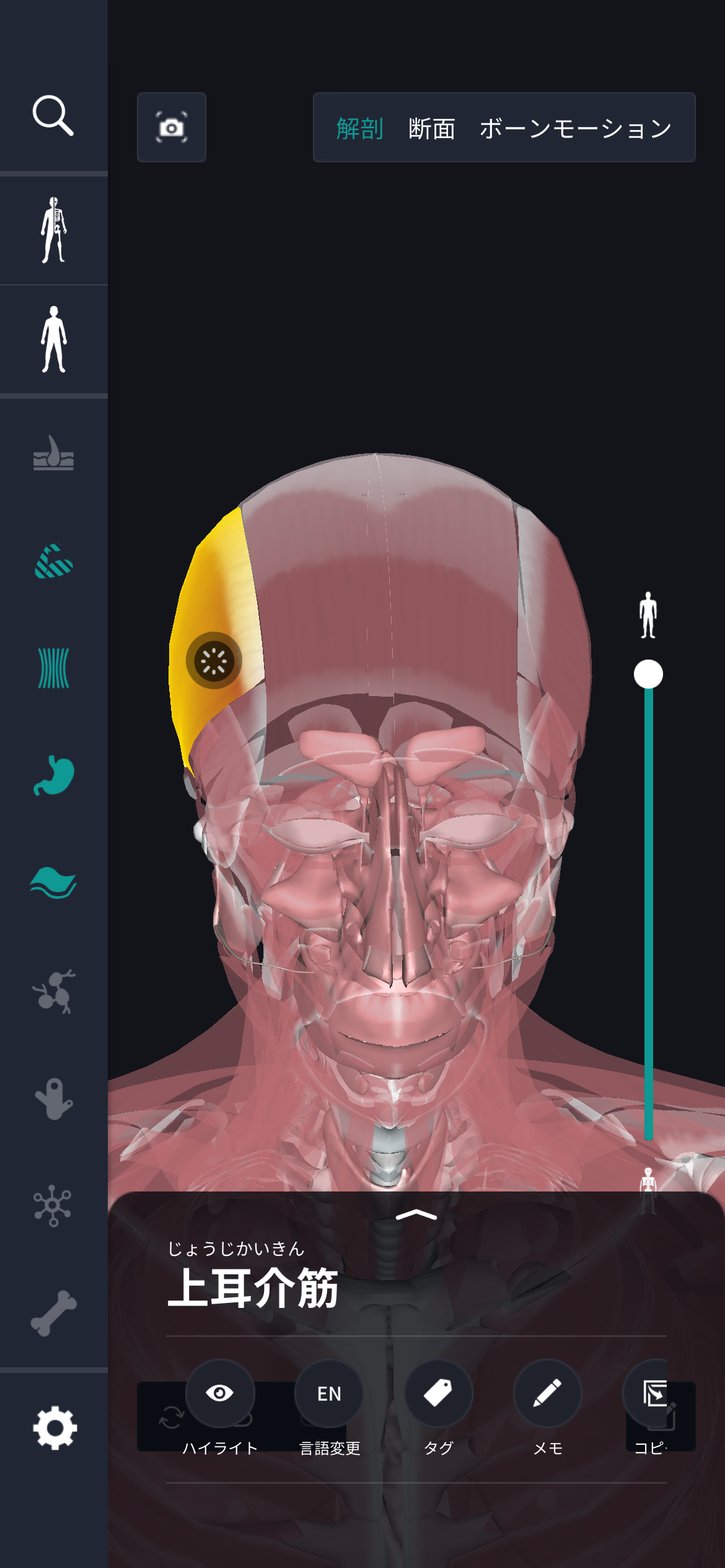
Now, I'll explain the details about the “superior auricular muscle” and how to study human anatomy.
teamLab Body Pro Free Download
A 3D anatomy app that shows all the structures of the human body
Download teamLab Body Pro here!
What is the superior auricular muscle?
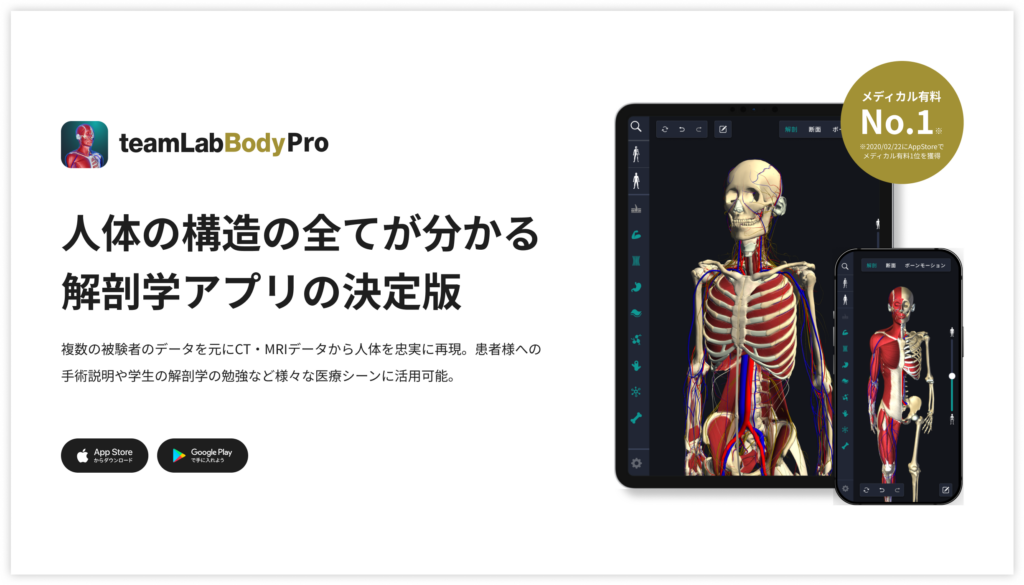
In the anatomy application, you can view a selection of anatomy 3D models. In this model, there are various observation methods such as surfaces, cross-sections, and nervous systems. This time, I'll explain using an anatomy application.
About superior auricular muscle
The superior auricular muscle is a small muscle at the top of the ear that mainly works to move the auricle (structure outside the ear). This muscle is part of the facial muscles and is intended to be able to move the ears and change the position of the ears. However, for the majority of people, this muscle plays almost no role. The superior auricular muscle is thought to be a remnant of what animals used in the past to move their ears to find the direction of sound. Modern humans have limited ability to move their ears, but some people can use this muscle to move their ears slightly. Anatomically, this muscle is connected to the skin at the top of the ear, but its functional importance is low, and it rarely plays a prominent role. Therefore, its importance from a clinical point of view is limited, and it is mainly treated as an anatomical study or interest.
Study points
Location and structure of superior auricular muscle
The superior auricular muscle is a small muscle located at the top of the ear and is responsible for the movement of the auricle. This muscle is connected to the upper part of the auricle and the skin on the side of the skull, and has the role of moving the ear and slightly changing its position. The superior auricular muscle extends to the side of the auricle and has the function of pulling the auricle up, but for many people, this function is very limited. Since the human auricular muscle has been relatively degenerated compared to many other mammals during evolution, the ability to move the auricle is not well developed. Locationally, it is located just below the skin at the top of the auricle, and although it is in a layer deeper than the epidermis, it is smaller than other important auricular structures, and is mostly surrounded by fat from muscle. Therefore, there are other muscles related to auricular movement around this muscle, but the superior auricular muscle itself does not have a prominent function, and it cooperates with other muscles to fine-tune the movement of the auricle.
The role and function of the superior auricular muscle
The primary role of the superior auricular muscle is to slightly adjust the movement of the auricle, but its work is limited. In humans, this muscle does not play such an important role and is thought to be relatively degenerated. In many mammals, the function of moving the ears is well developed, so the auricular muscle plays an active role in searching for the direction of sound, but in humans, this function is almost lost. The superior auricular muscle moves the ear to improve sound direction, and may slightly affect facial movements as part of the facial muscles. However, their movements are so minute that most people cannot move their ears consciously. Only some people can control ear movements, and even in such cases, movements are almost impossible to visually confirm. The work of this muscle includes lifting the auricle, but its range of motion is very limited compared to other facial and neck muscles. As a result, the role of the superior auricular muscle exists mainly as an evolutionary heritage and does not have a significant impact on practical sound or facial functions. However, its existence is interesting for anatomical research and considering evolutionary processes.
English notation for superior auricular muscle
The superior auricular muscle is expressed as “superior auricular muscle” in English. The name of this muscle describes its position and function. “Superior” means “at the top,” and “auricular” means “related to the auricle.” Therefore, “superior auricular muscle” means “muscle located above the auricle.” This name is used to describe anatomical structures and is commonly used in the medical and biological fields. This muscle is at the top of the ear and plays a small role in moving the auricle, but in humans, its function is degenerative. Other mammals use this muscle to move their ears and search for the direction of sound, but in humans, that ability is limited, and it is thought to complement the movement of ears and facial expressions psychologically. English notation is a standard notation recognized internationally, and is widely used in academic papers and anatomy textbooks. Understanding this name can help you deepen your knowledge about the structure of the ear and face in anatomy.
How to study human anatomy
I will explain specific study methods using human anatomy applications.
Check your past learning history and practice repeatedly
Here are the steps to check your anatomy learning history and practice iteratively effectively.
1. Check your learning history in the app
Reviewing your learning history with the application is an important step in effectively advancing anatomy learning. First, launch the app and go to the learning history section from the main menu. Many anatomy apps are designed to show your progress in the form of graphs and lists, so you can visually check which parts you've learned about and how much time you've spent.
By using this data, you can understand which areas you have strengths in and where you need to spend more time and effort. We also recommend using a dedicated tag or notebook function to mark areas you are particularly weak at or where you need to relearn. Regularly checking your learning history and looking back on past learning content will lead to efficient review and deepening understanding.
2.Make a plan for iterative learning
Making an efficient repetitive learning plan based on learning history is extremely effective in promoting knowledge retention. First, identify weak points and areas where you need to relearn. Next, arrange these study items into a weekly or monthly calendar and create a specific study schedule. By proceeding in a planned manner, you can learn each part evenly and avoid packing in a large amount of information at once.
Using a task management app or digital calendar to set study reminders is effective. Also, it's important to have the flexibility to regularly review progress and revise plans as needed. By having goals and proceeding with your studies in a planned manner, you can efficiently acquire anatomical knowledge.
3.Use 3D features to learn visually
By utilizing the 3D function, learning anatomy is easier to understand visually. The 3D model shows the structure of the human body three-dimensionally, and each part can be observed in detail. This makes it possible to intuitively grasp positional relationships between deep muscles and organs that are difficult to capture in a planar view. For example, you can learn even the smallest details by rotating specific muscles and bones and zooming in and out.
Also, there are many apps that have the function of displaying cross-sectional views of each part using a 3D model, which is useful for deepening understanding of internal structures. This diversity of visual information helps with memory retention and improves immediate responsiveness in tests and practice situations. By utilizing the 3D function and learning visually, you can learn anatomy knowledge more deeply and efficiently.
Use the memo function concretely
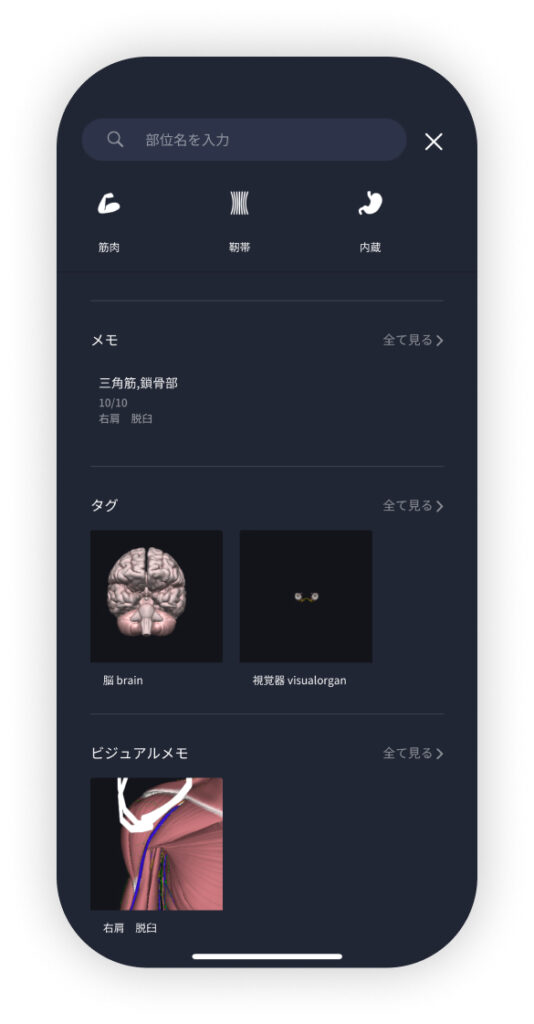
Make notes so you don't forget the things and points you've noticed while studying. The memo function can be used for different purposes, such as inputting text, saving images, and writing memos. Tag your notes to make them easier to review later.
Test your learning regularly in the form of quizzes
Regularly testing what you've learned in a quiz format is a very effective way to anchor your anatomy knowledge. Quiz-style tests help you objectively grasp your level of understanding and areas you lack while repeating knowledge.
For example, by using a learning app to conduct quizzes every specific period, you can reconfirm what you've learned and strengthen your memory. There are a wide range of quiz formats, such as multiple choice questions, fill-in-the-blank questions, and short answer questions, and each helps understanding from a different angle and develops the ability to utilize various types of knowledge.
Get feedback
If possible, get feedback from other learners and experts. It helps you find your own gaps in understanding and areas for improvement. You can also keep yourself motivated to learn by regularly testing yourself. Feeling a sense of accomplishment and progress increases motivation for continuous learning.
summary
This time, I explained how to study “superior auricular muscle” using an application!
Thank you for reading this far.
I would be happy if reading this article helped you learn about anatomy.
Learning is a long, never-ending journey, but I sincerely wish you all the best. Let's continue to study together and work hard for the national exam!
Please look forward to the next blog.