beginning
In this article, I will explain effective study methods, starting with knowledge of specialized parts in human anatomy.
In human anatomy, it is necessary not only to memorize the names of various organs, muscles, and bones, but also to remember where they are located in the body. Therefore, it is necessary to learn as efficiently as possible.
I hope you can read this article and use the app to deepen your understanding even a little bit.
Now, I'll explain the details about the “left ventricle” and how to study human anatomy.
teamLab Body Pro Free Download
A 3D anatomy app that shows all the structures of the human body
Download teamLab Body Pro here!
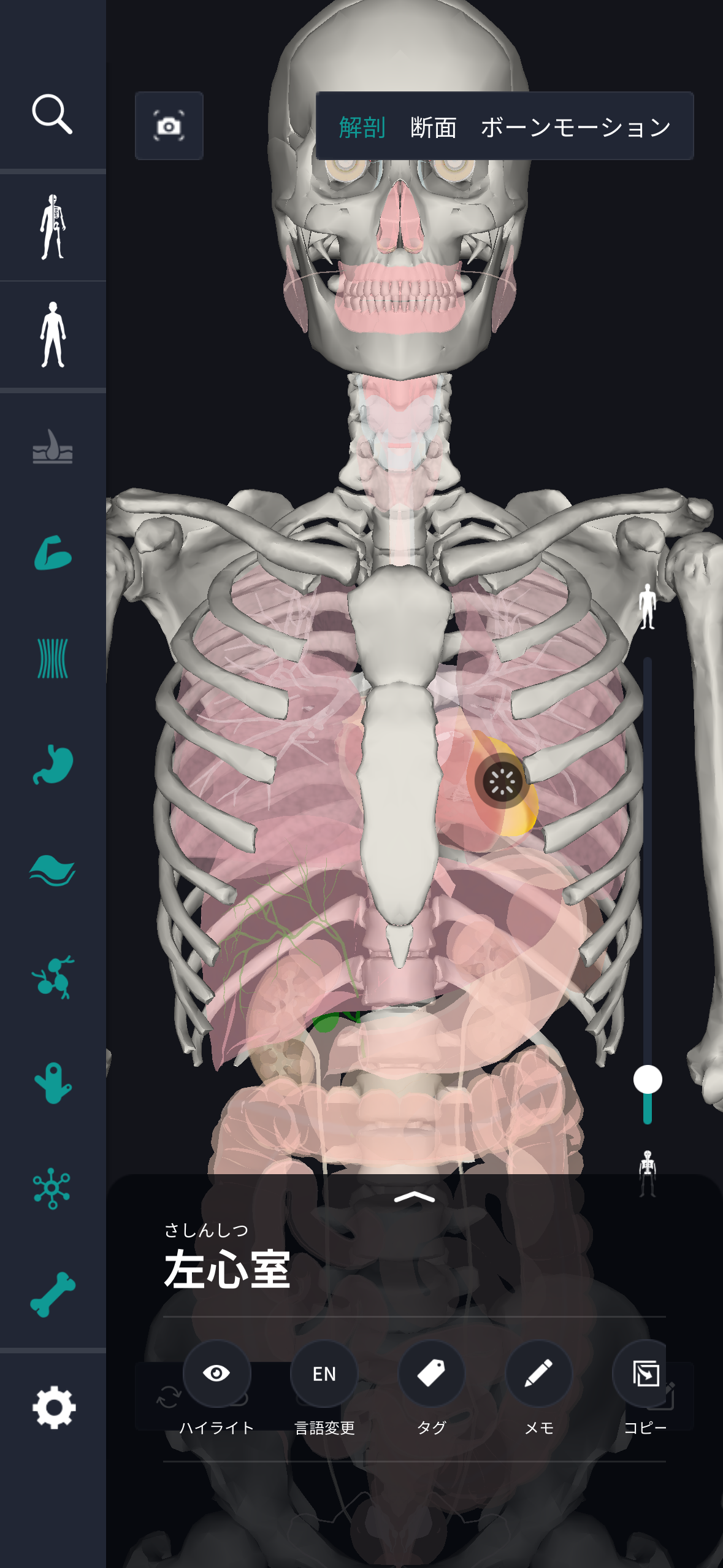
What is the left ventricle?
In the anatomy application, you can view a selection of anatomy 3D models. In this model, there are various observation methods such as surfaces, cross-sections, and nervous systems. This time, I'll explain using an anatomy application.
About the left ventricle
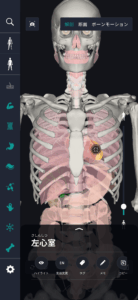
Study points
Location and structure of the left ventricle
The left ventricle is located in the lower left side of the heart and is a particularly important part of the four-chamber heart. Structurally, the left ventricle has strong muscles, which are necessary to efficiently pump oxygen-rich blood throughout the body. This chamber receives blood from the upper left atrium and pumps blood to the aorta through the lower aortic valve. The wall of the left ventricle is very thick, which is a characteristic of this room. This is because high pressure is needed to pump blood throughout the body. Muscle fibers are intricately arranged inside, creating a force that pushes blood strongly. The shape of the ventricle is close to a cone, and the narrow tip is called the apex of the heart, and is designed to work effectively as part of the heart as part of the heart. The overall structure of the heart is optimized to efficiently deliver nutrients and oxygen throughout the body. Among them, the left ventricle plays a role in pumping blood with maximum pressure, and a strong structure and positional relationship is required just that.
The role and function of the left ventricle
The main function of the left ventricle is to pump oxygen-rich blood throughout the body. This process is an essential function for life support. The left ventricle receives blood from the left atrium and pumps that blood through the aorta throughout the body with high pressure. This process is carried out by contraction and relaxation of the heart. When the left ventricle contracts, blood is forcefully pushed out and sent to various tissues through the aorta. This series of movements is felt as a “heart beat,” and it is one of the important vital indicators measured as heart rate in our daily lives. The left ventricle is also responsible for maintaining high pressure in the circulatory system. Therefore, it is necessary for the heart to function properly at all times, even in normal lifestyle activities, and it is an important factor for maintaining health. For this reason, maintaining a lifestyle that is conscious of heart health is recommended, and regular exercise and a balanced diet are required. Thus, the left ventricle is the center of circulation that supports life, and plays an essential role in maintaining all physical functions optimally.
English notation for left ventricle
In English, “left ventricle” is expressed as “left ventricle.” This term is commonly used as a technical term for the circulatory system and refers to the chamber in the heart that has the main pumping function of pumping blood throughout the body. In English, “left” means “left,” and “ventricle” is a word indicating “ventricle.” This combination accurately shows the left ventricle anatomically. The left ventricle is particularly important among the four chambers of the heart, and it has the role of pumping blood throughout the body through arteries. Even in English-speaking countries, this section is frequently taken up in clinical and educational settings, and its function and importance are explained. This term is a part where basic understanding is required when learning the anatomy and physiology of the heart. It may also be seen in general health information or fitness contexts. In order to maintain heart health, it is important to understand the role and function of this part, and the expression “left ventricle” appears frequently in specialized literature. Understanding English notation makes it easier to access international medical information and literature, and also helps expand the range of knowledge in health management.
How to study human anatomy
I will explain specific study methods using human anatomy applications.
Check your past learning history and practice repeatedly
Here are the steps to check your anatomy learning history and practice iteratively effectively.
1. Check your learning history in the app
Reviewing your learning history with the application is an important step in effectively advancing anatomy learning. First, launch the app and go to the learning history section from the main menu. Many anatomy apps are designed to show your progress in the form of graphs and lists, so you can visually check which parts you've learned about and how much time you've spent.
By using this data, you can understand which areas you have strengths in and where you need to spend more time and effort. We also recommend using a dedicated tag or notebook function to mark areas you are particularly weak at or where you need to relearn. Regularly checking your learning history and looking back on past learning content will lead to efficient review and deepening understanding.
2.Make a plan for iterative learning
Making an efficient repetitive learning plan based on learning history is extremely effective in promoting knowledge retention. First, identify weak points and areas where you need to relearn. Next, arrange these study items into a weekly or monthly calendar and create a specific study schedule. By proceeding in a planned manner, you can learn each part evenly and avoid packing in a large amount of information at once.
Using a task management app or digital calendar to set study reminders is effective. Also, it's important to have the flexibility to regularly review progress and revise plans as needed. By having goals and proceeding with your studies in a planned manner, you can efficiently acquire anatomical knowledge.
3.Use 3D features to learn visually
By utilizing the 3D function, learning anatomy is easier to understand visually. The 3D model shows the structure of the human body three-dimensionally, and each part can be observed in detail. This makes it possible to intuitively grasp positional relationships between deep muscles and organs that are difficult to capture in a planar view. For example, you can learn even the smallest details by rotating specific muscles and bones and zooming in and out.
Also, there are many apps that have the function of displaying cross-sectional views of each part using a 3D model, which is useful for deepening understanding of internal structures. This diversity of visual information helps with memory retention and improves immediate responsiveness in tests and practice situations. By utilizing the 3D function and learning visually, you can learn anatomy knowledge more deeply and efficiently.
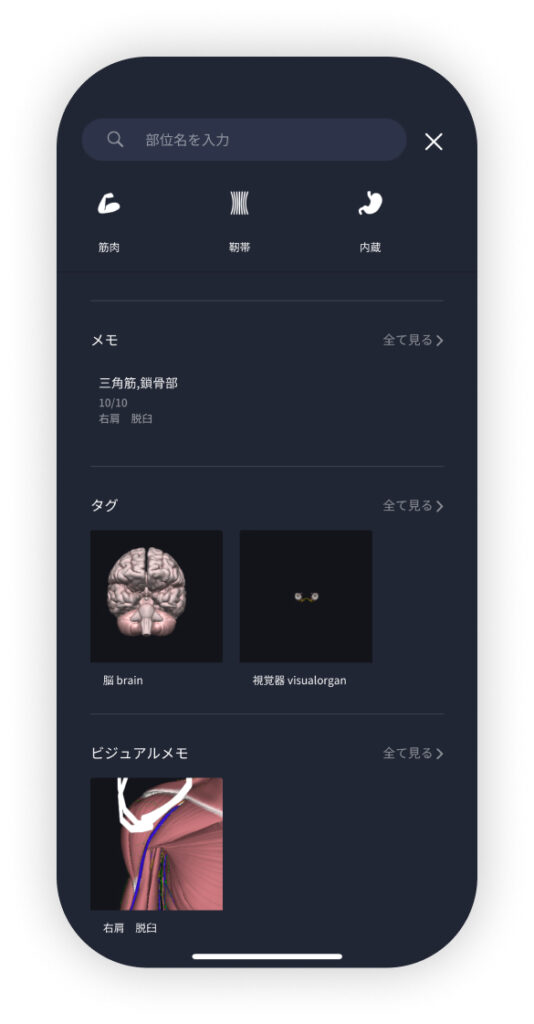
Use the memo function concretely
Test your learning regularly in the form of quizzes
Regularly testing what you've learned in a quiz format is a very effective way to anchor your anatomy knowledge. Quiz-style tests help you objectively grasp your level of understanding and areas you lack while repeating knowledge.
For example, by using a learning app to conduct quizzes every specific period, you can reconfirm what you've learned and strengthen your memory. There are a wide range of quiz formats, such as multiple choice questions, fill-in-the-blank questions, and short answer questions, and each helps understanding from a different angle and develops the ability to utilize various types of knowledge.
Get feedback
If possible, get feedback from other learners and experts. It helps you find your own gaps in understanding and areas for improvement. You can also keep yourself motivated to learn by regularly testing yourself. Feeling a sense of accomplishment and progress increases motivation for continuous learning.
summary
This time, I explained how to study about the “left ventricle” using an application!
Thank you for reading this far.
I would be happy if reading this article helped you learn about anatomy.
Learning is a long, never-ending journey, but I sincerely wish you all the best. Let's continue to study together and work hard for the national exam!
Please look forward to the next blog.