beginning
In this article, I will explain effective study methods, starting with knowledge of specialized parts in human anatomy.
In human anatomy, it is necessary not only to memorize the names of various organs, muscles, and bones, but also to remember where they are located in the body. Therefore, it is necessary to learn as efficiently as possible.
I hope you can read this article and use the app to deepen your understanding even a little bit.
Now, I'll explain the details about the “anal canal” and how to study human anatomy.
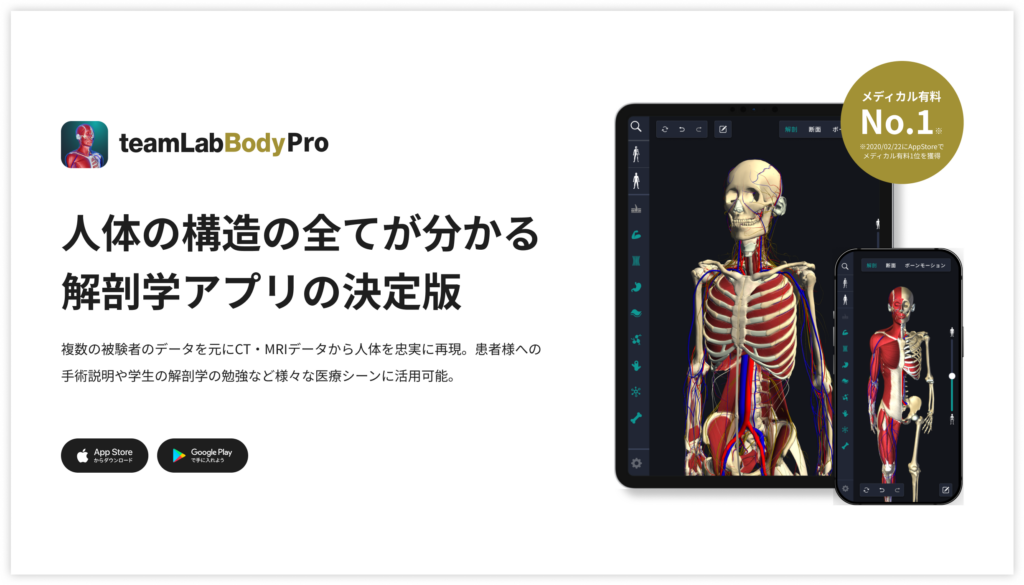
teamLab Body Pro Free Download
A 3D anatomy app that shows all the structures of the human body
Download teamLab Body Pro here!
What is an anal canal?
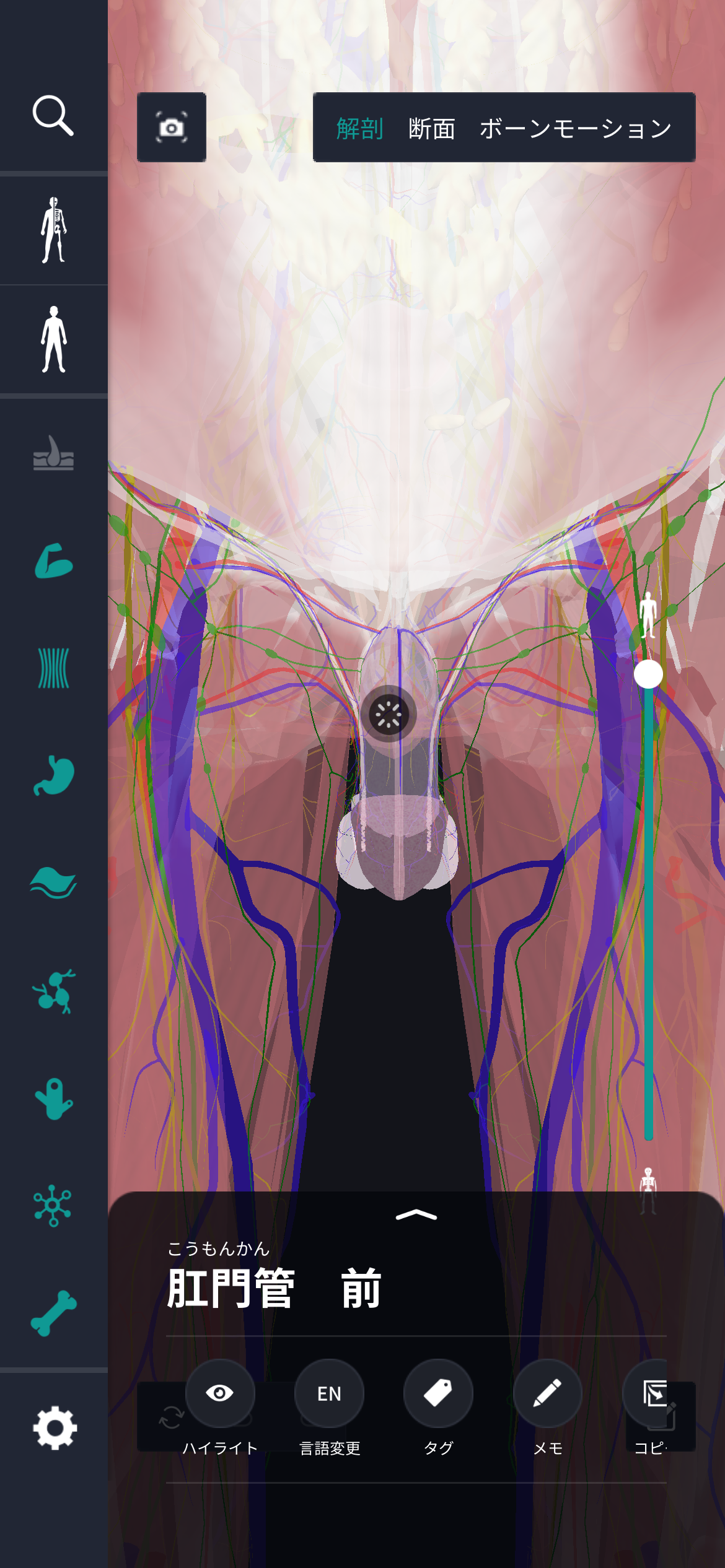
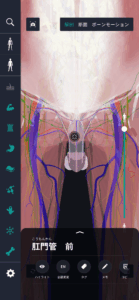
In the anatomy application, you can view a selection of anatomy 3D models. In this model, there are various observation methods such as surfaces, cross-sections, and nervous systems. This time, I'll explain using an anatomy application.
About anal canal
Study points
The location and structure of the anal canal
The anal canal is the final part of the human body's digestive system and is the channel leading from the rectum to the anus. Its location is in the lower abdomen of the body and is closely linked to the muscles and nerves that form the pelvic floor. This anal canal is an important channel for draining contents produced during each stage of digestion, and regulates excretion. The structure of the anal canal includes the inner mucous membrane, the muscle layer, and the outer skin. Mucous membranes provide a smooth surface, play a role in making it easier for contents to pass through, and also play a protective function to prevent foreign matter and bacteria from entering. The muscle layer has many layers of sphincters, which control bowel movements by opening and closing the anus. There are internal anal sphincters and external anal sphincters, and each has different muscle types and functions. These muscles work in concert to allow us to consciously control our bowel movements. The skin layer supports the entire structure while protecting the mucous membranes and muscles. Due to this structure and function, the anal canal forms part of the human body's important excretion mechanism and contributes to maintaining health.
The role and function of the anal canal
As for the role of the anal canal, it is the last important part of the digestive system, which efficiently excretes excrement from the body. Food debris that has passed through the digestive system travels through the large intestine to the anal canal, where it is excreted from the body as needed. This process is essential for maintaining human health, and removes excess substances and toxins from the body. In addition, the anal canal also has a function to control excretion, and defecation based on intention is possible due to the function of the autonomic nervous system and muscles. There is a muscle layer in the anal canal, and this muscle plays an important role in regulating the accumulation of excrement and the timing of discharge. Furthermore, the mucous membranes protect the interior and help the smooth movement of excrement by smoothing the surface. By all of these working in concert, the anal canal supports smooth excretion activities in daily life. Maintaining anal canal health is very important for keeping the digestive process smooth and maintaining general health. Regular exercise and a nutritionally balanced diet are basic strategies for optimizing the work of the anal canal.
English notation for anal canal
The notation for “anal canal” in English is “anal canal.” Here, I will focus on language sounds and usage situations while avoiding medical and technical content related to English notation. This word is used as an anatomical term in the English-speaking world, and is particularly often heard in education and research. The English notation simply conveys its structure and function. “Anal” means “relating to the anus,” and since “canal” means “duct” or “passage,” the meaning of “anal passage” is expressed in an easy-to-understand manner. “Anal canal” is an expression frequently used in anatomy textbooks, medical-related publications, or in professional discussions. It is rarely used in everyday conversation, but it is an important term for understanding its role and structure in health-related education. In the English-speaking world, this standard term is used for anatomical explanations and related medical illustrations. As an interesting point, the English notation is phonetic compared to the Japanese word “anal canal,” and it also has the characteristic that it is relatively easy to intuitively understand the pronunciation. Thus, it can be seen that even when language expressions are different, they play a role in helping to understand their significance and function.
How to study human anatomy
I will explain specific study methods using human anatomy applications.
Check your past learning history and practice repeatedly
Here are the steps to check your anatomy learning history and practice iteratively effectively.
1. Check your learning history in the app
Reviewing your learning history with the application is an important step in effectively advancing anatomy learning. First, launch the app and go to the learning history section from the main menu. Many anatomy apps are designed to show your progress in the form of graphs and lists, so you can visually check which parts you've learned about and how much time you've spent.
By using this data, you can understand which areas you have strengths in and where you need to spend more time and effort. We also recommend using a dedicated tag or notebook function to mark areas you are particularly weak at or where you need to relearn. Regularly checking your learning history and looking back on past learning content will lead to efficient review and deepening understanding.
2.Make a plan for iterative learning
Making an efficient repetitive learning plan based on learning history is extremely effective in promoting knowledge retention. First, identify weak points and areas where you need to relearn. Next, arrange these study items into a weekly or monthly calendar and create a specific study schedule. By proceeding in a planned manner, you can learn each part evenly and avoid packing in a large amount of information at once.
Using a task management app or digital calendar to set study reminders is effective. Also, it's important to have the flexibility to regularly review progress and revise plans as needed. By having goals and proceeding with your studies in a planned manner, you can efficiently acquire anatomical knowledge.
3.Use 3D features to learn visually