beginning
In this article, I will explain effective study methods, starting with knowledge of specialized parts in human anatomy. In human anatomy, it is necessary not only to memorize the names of various organs, muscles, and bones, but also to remember where they are located in the body. Therefore, it is necessary to learn as efficiently as possible. I hope you can read this article and use the app to deepen your understanding even a little bit. Now, I'll explain the details about the “levator ulnar superior labial muscle” and how to study human anatomy.teamLab Body Pro Free Download
A 3D anatomy app that shows all the structures of the human body
Download teamLab Body Pro here!

What is levator ulnar superior labial muscle?
In the anatomy application, you can view a selection of anatomy 3D models. In this model, there are various observation methods such as surfaces, cross-sections, and nervous systems. This time, I'll explain using an anatomy application.About levator ulnar superior labial muscle

Study points
Location and structure of the levator ulnar superior labial muscle
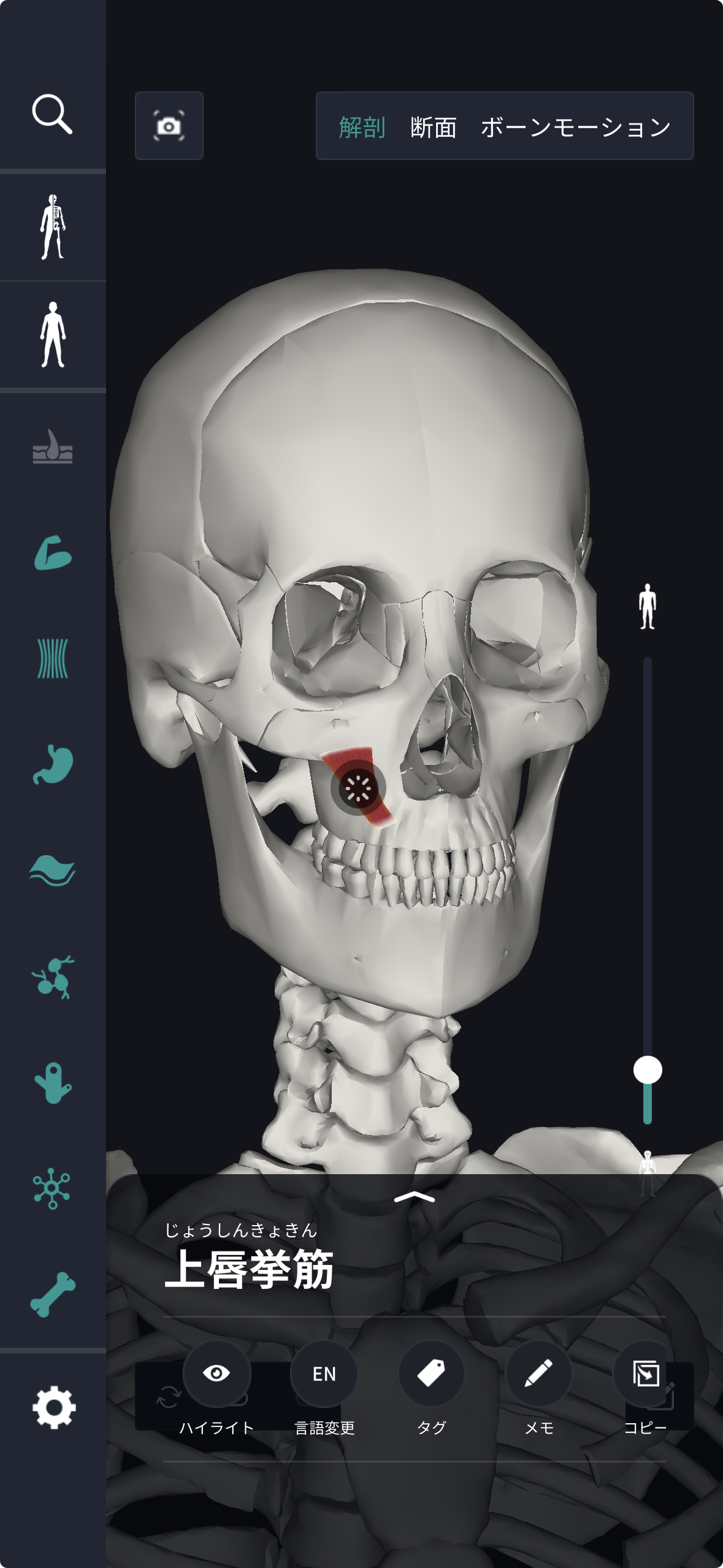
The levator labialis muscle is a muscle located in the central part of the face, specifically between the nose and upper lip. This muscle originates from the maxilla and extends to the outside of the wing of the nose and upper lip. Structurally, the levator labialis muscle is an elongated band, and like many facial muscles, it works in a layer close to the epidermis. Due to this position, the levator superior labial muscle plays a very important role in forming facial expressions. The levator superior labial muscle works in cooperation with other muscles in the upper part of the face to create subtle expressions. Due to this muscle movement, when the upper lip is lifted, a smile or a surprised expression can be created. Because it is in the center of the face, the movement of this muscle has a significant impact on the overall facial expression. Also, the levator superior labial muscle is an important factor in shaping the natural beauty and unique expression of the face. Its position based on facial structure is one of the factors that make an individual's face unique and different from others. By understanding facial muscles, you can learn how individual facial expressions are formed. The structure and location of this muscle may be key to understanding nonverbal communication. Analyzing facial features that express feelings and intentions can enrich people's social interactions and help us understand differences in expression depending on cultural background.The role and function of the levator ulnar superior labial muscle
The role and function of the levator superior labial muscle is an essential element in the formation of facial expressions. The main function of this muscle is to lift the upper lip. As a result, expressions such as smiles, surprise, and confusion are naturally created, and it is a nonverbal means of conveying individual feelings and intentions. The levator superior labial muscle is active in various situations in everyday life. For example, when laughing, it lifts the upper lip and works to give brightness to the face. Also, when surprised, lips are pulled up, which visually expresses that emotion. In this way, the levator superior labial muscle plays a very important role in emotional expression and stimulates communication. In addition, this muscle also affects the aesthetic balance of the face. It can create natural expressions and enhance impression and appeal. By moving the levator superior labia muscle, the overall movement and harmony of the face is maintained, and the impression on others also has a significant effect. The levator superior labia muscle is also a factor that creates differences in expression due to individual individuality and cultural background. By understanding how facial muscles work, you can learn how facial expressions reflect emotions and aid communication. Facial expression muscles provide an important means for enriching human social interaction and deepening communication.English notation for levator ulnar superior labialis muscle
The English notation for levator superior labia muscle is “Levator labii superioris.” The name indicates the role or characteristics that muscles play. First, the “levator” part means “lift,” which indicates that this muscle works to pull up the upper lip. “Labii” refers to “lips.” “superioris” is translated as “above, above,” and it expresses that this muscle is at the top of the face. This name clarifies the position and role of muscles from an anatomical point of view, but such technical terms are not often used in everyday life. English notation is mainly used in medical and anatomical academic settings. When the general public needs to understand this muscle, it is often described as the muscle that lifts the upper lip. The name itself is derived from Latin and is part of an internationally standardized notation, as are many anatomical terms. This standardized English notation makes it possible for medical professionals and researchers around the world to communicate in a common language, expanding the space for knowledge sharing and learning. In medical settings, by using such English notation, medical cooperation and information exchange across national borders are carried out smoothly.How to study human anatomy
I will explain specific study methods using human anatomy applications.Check your past learning history and practice repeatedly
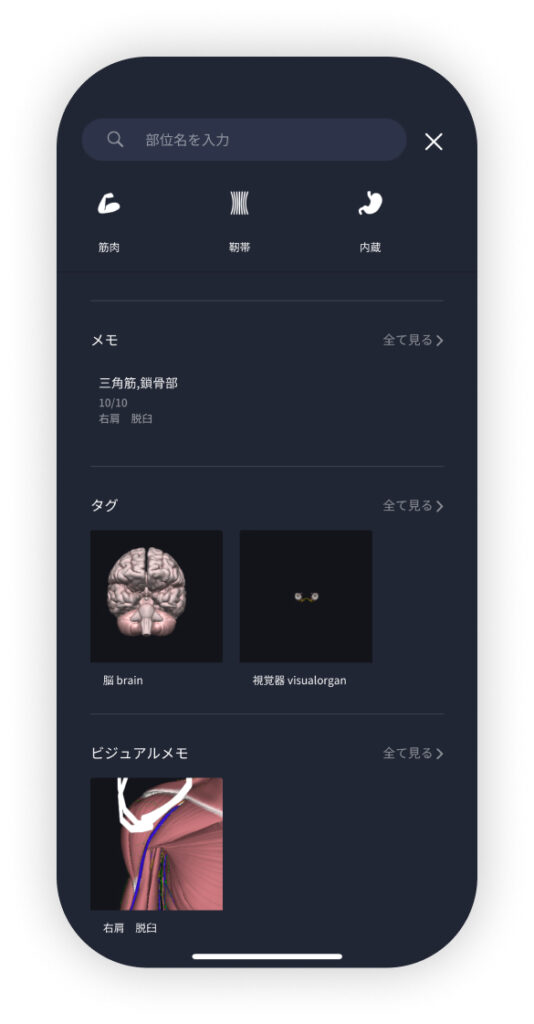
Here are the steps to check your anatomy learning history and practice iteratively effectively. 1. Check your learning history in the appReviewing your learning history with the application is an important step in effectively advancing anatomy learning. First, launch the app and go to the learning history section from the main menu. Many anatomy apps are designed to show your progress in the form of graphs and lists, so you can visually check which parts you've learned about and how much time you've spent.
By using this data, you can understand which areas you have strengths in and where you need to spend more time and effort. We also recommend using a dedicated tag or notebook function to mark areas you are particularly weak at or where you need to relearn. Regularly checking your learning history and looking back on past learning content will lead to efficient review and deepening understanding.
Use the memo function concretely