Biceps femoris: location, long and short head origin and insertion, nerve supply
Where is the biceps femoris?
Sit on a chair and put a finger on the outer side of the back of your knee. Press your heel back into the floor and a firm cord stands out: the tendon of the biceps femoris.
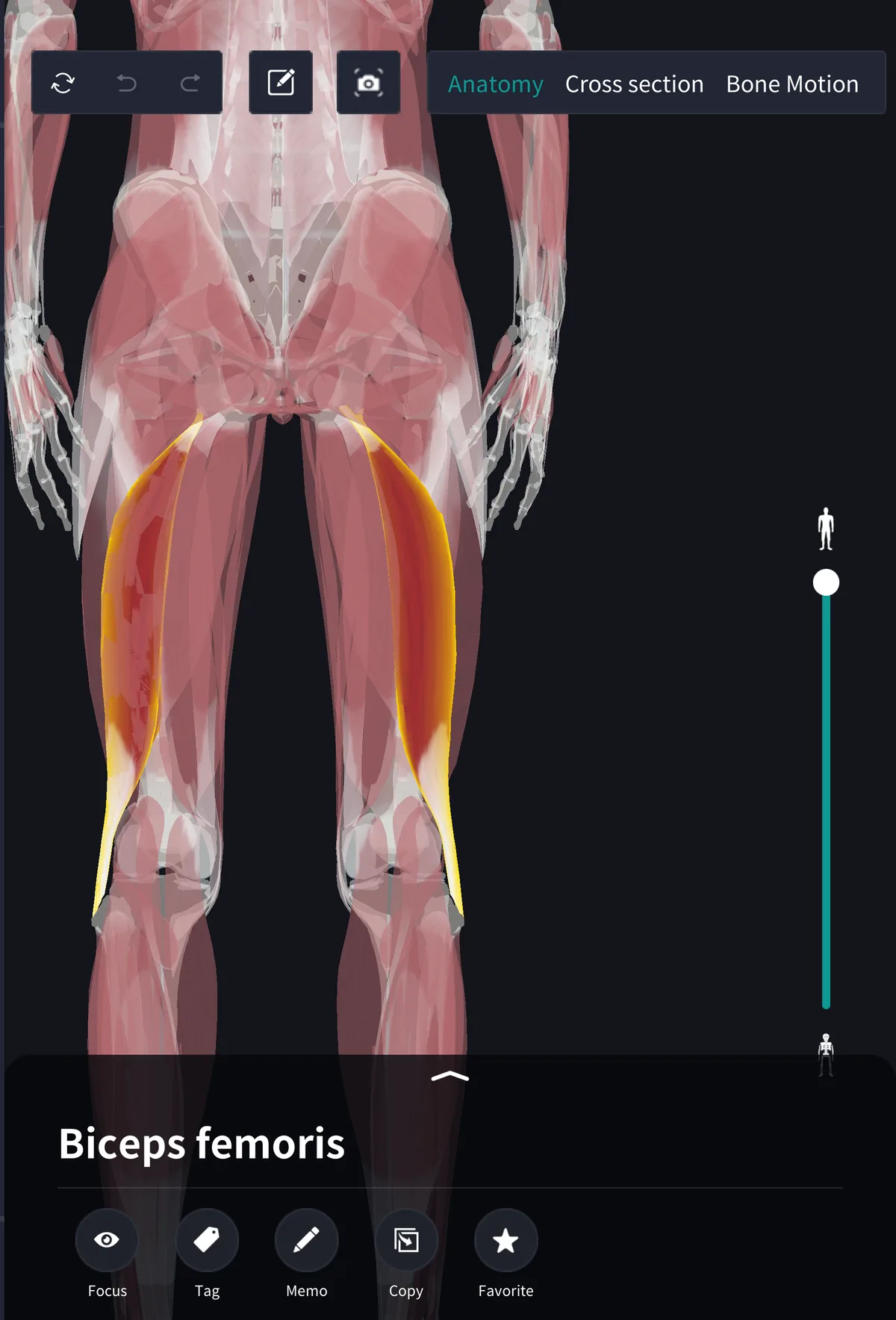
The biceps femoris runs obliquely from below the pelvis to the outer side of the knee. The muscles at the back of the thigh are called the hamstrings: the biceps femoris, semitendinosus and semimembranosus. Only the biceps femoris is on the lateral side; the other two lie medially. Seen from behind, its tendon forms the lateral border of the hollow behind the knee (the popliteal fossa).
Long head and short head
・Long head: from the ischial tuberosity at the bottom of the ischium, sharing a tendon with the semitendinosus and attaching to the sacrotuberous ligament
・Short head: from the lateral lip of the linea aspera, the ridge down the back of the femur, around mid-thigh
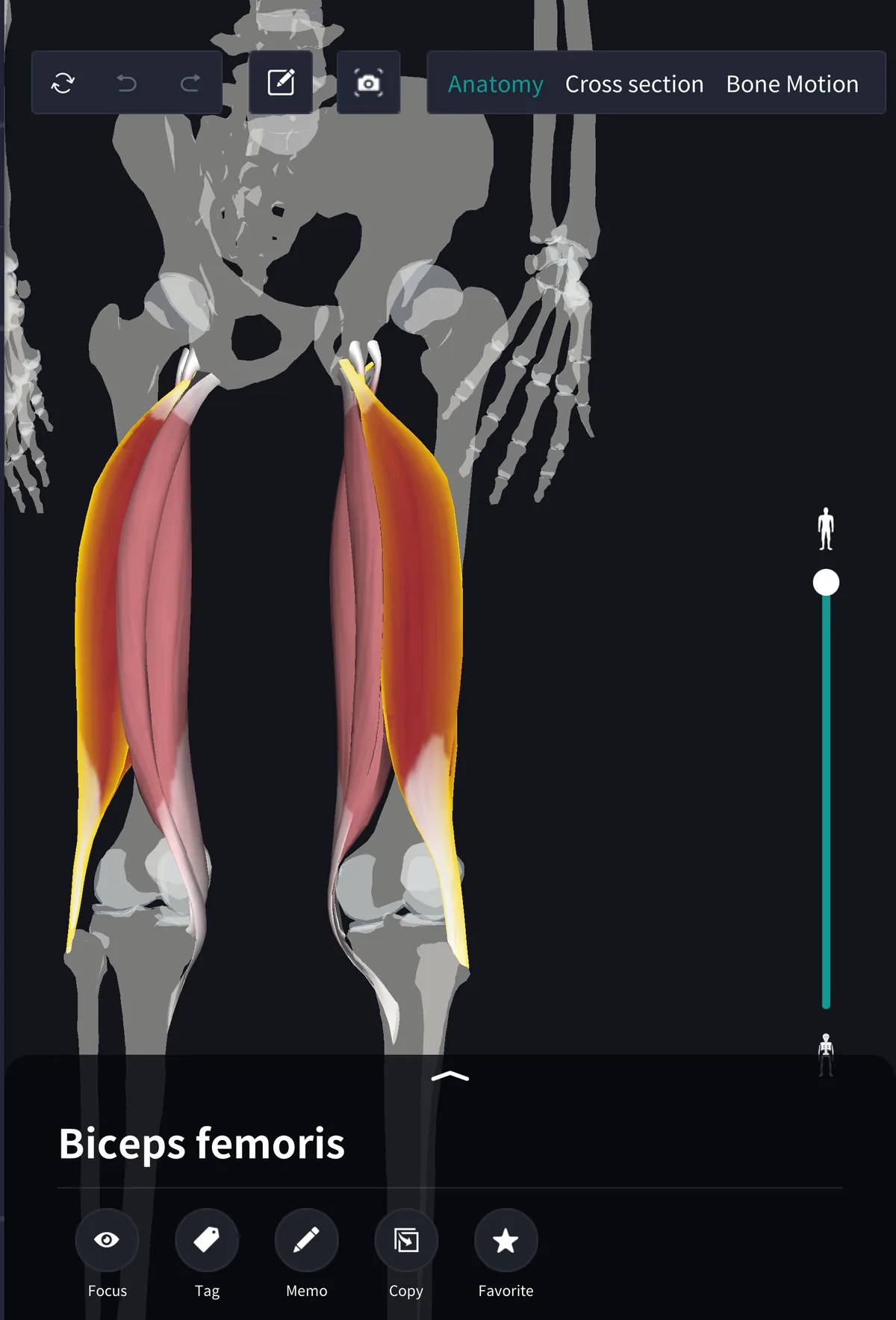
The two heads join low in the thigh and form one tendon that inserts on the head of the fibula, with some fibres reaching the lateral condyle of the tibia and the fascia of the leg. The lateral collateral ligament also attaches to the fibular head, and the biceps tendon splits around it. Because the short head does not arise from the pelvis, some textbooks do not count it as part of the hamstrings.
Knee flexion and lateral rotation
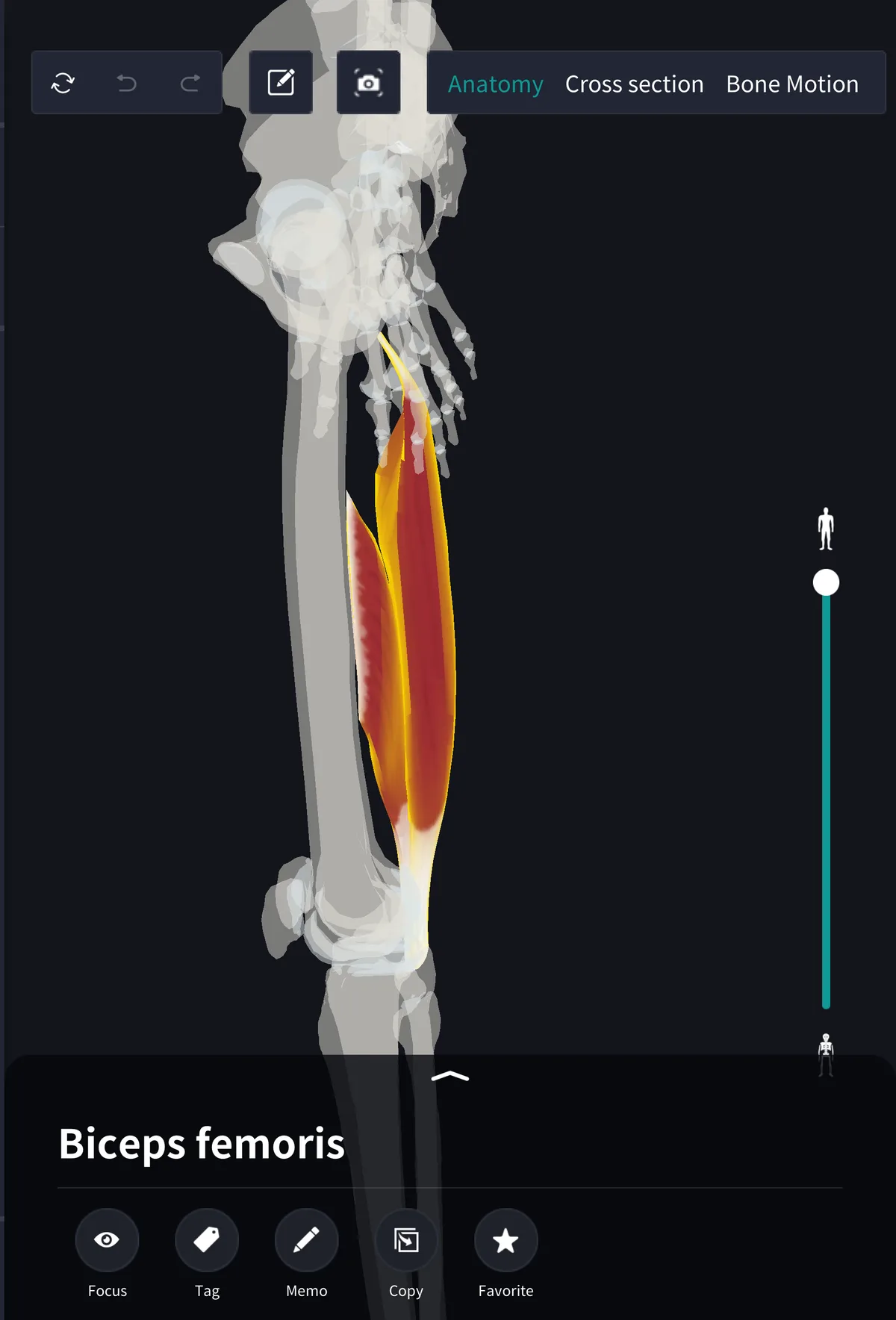
Its main action is to flex the knee. With the knee bent, it also rotates the leg laterally; it is the only hamstring that does, while the semitendinosus and semimembranosus rotate it medially. The long head crosses both the hip and knee, so it also extends the hip. The short head crosses only the knee.
Two heads, two nerves
Both heads are supplied by branches of the sciatic nerve: the long head by its tibial part and the short head by its common fibular part. Every other hamstring muscle is supplied by the tibial part, so the short head is the only one with a common fibular supply. The common fibular nerve runs along the medial edge of the biceps tendon behind the knee and winds around just below the fibular head.
Name and terms
Biceps means two heads and femoris means of the thigh. The biceps of the arm is the biceps brachii; on its own, biceps usually means the arm muscle, so the thigh muscle is named in full. The Latin is musculus biceps femoris.
See it in the app
The back of the thigh has several layers of muscle, so a single posterior view rarely makes clear which one runs laterally. In the 3D anatomy app teamLabBody you can hide the other muscles, keep only the three hamstrings, and rotate them to follow the biceps femoris out to the fibular head. Show the bones as well to see the ischial tuberosity and femur where the two heads arise. Cross sections are available with the PREMIUM plan.
FAQ
- Where is the biceps femoris?
- On the outer side of the back of the thigh. It arises from the ischial tuberosity and the femur and inserts on the head of the fibula; you can feel its tendon at the outer side of the back of the knee.
- Is the biceps femoris one of the hamstrings?
- Yes. The hamstrings are the biceps femoris, semitendinosus and semimembranosus, and the biceps femoris is the lateral one. Some textbooks leave out its short head.
- What is the difference between the long and short heads?
- The long head arises from the ischial tuberosity and crosses the hip and knee; the short head arises from the femur and crosses only the knee. The long head is supplied by the tibial nerve and the short head by the common fibular nerve.
Related articles
・Hamstrings: the three muscles at the back of the thigh
・Semitendinosus: shares its origin tendon with the long head
・Sciatic nerve: divides into the tibial and common fibular nerves
・Lateral collateral ligament: also attaches to the fibular head
・Quadriceps femoris: the knee extensors at the front of the thigh