Where is the atlas (C1)? Ring shape, dens, joints with the skull and axis
Where is the atlas?
Put a hand on the back of your neck and nod, then shake your head. Most of that movement happens where the skull meets the neck, and the bone at that junction is the atlas.
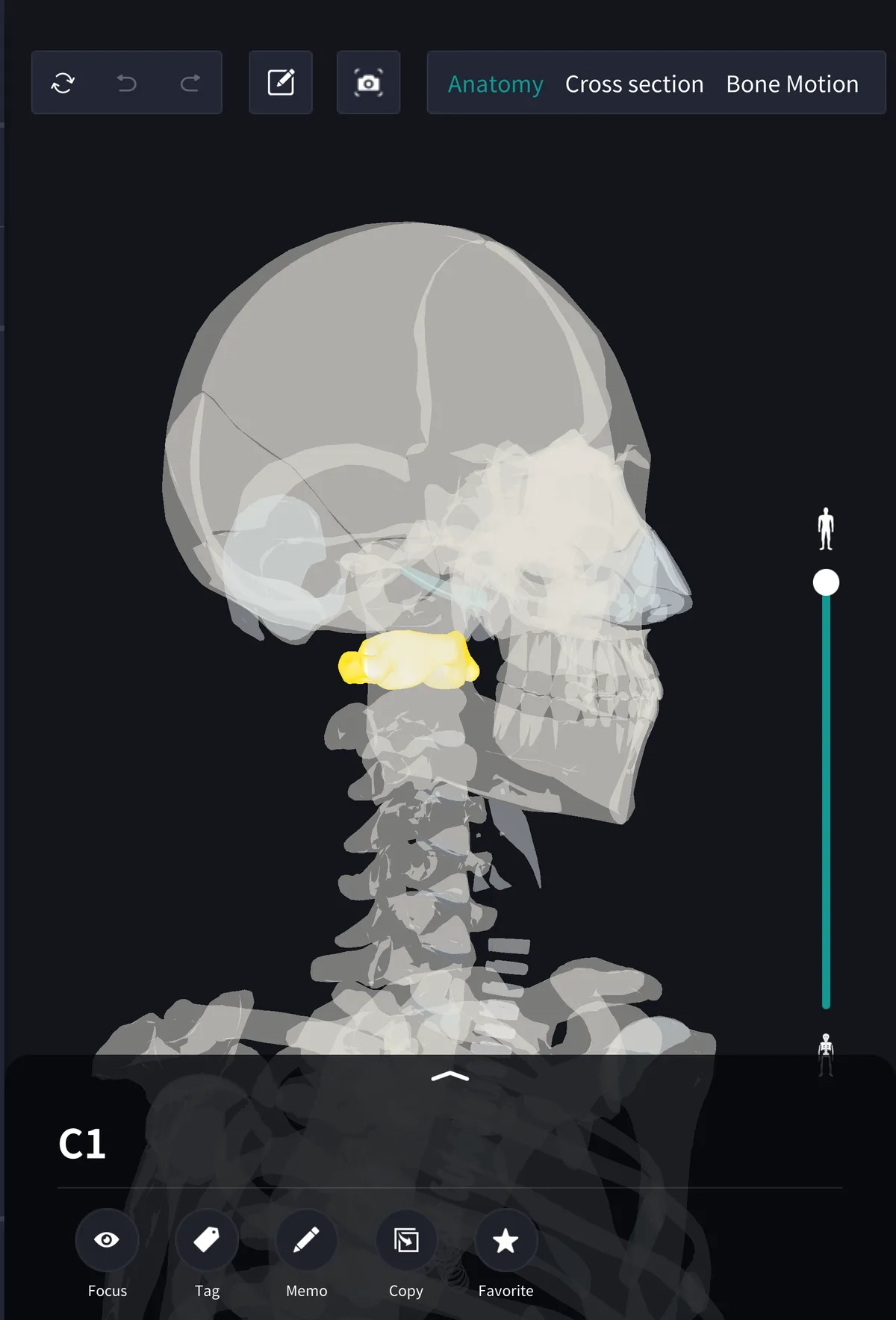
The atlas is the top of the seven cervical vertebrae, also written C1. It lies at about the level of the earlobe, just under the base of the skull. With the pharynx in front and several layers of neck muscle behind, it sits deep and is hard to feel clearly through the skin.
A ring: arches and lateral masses
Other cervical vertebrae have a cylindrical body and a spinous process pointing backwards. The atlas has neither. Seen from above it is almost a ring.
・Anterior arch: the thin front of the ring, with a small anterior tubercle in front and a facet for the dens on its inner surface
・Posterior arch: the back of the ring, with a small posterior tubercle instead of a spinous process and a groove for the vertebral artery on its upper surface
・Lateral masses: the thick sides, with facets above and below that carry the weight of the head down to the axis
・Transverse processes: wide for a cervical vertebra, each with a transverse foramen for the vertebral artery
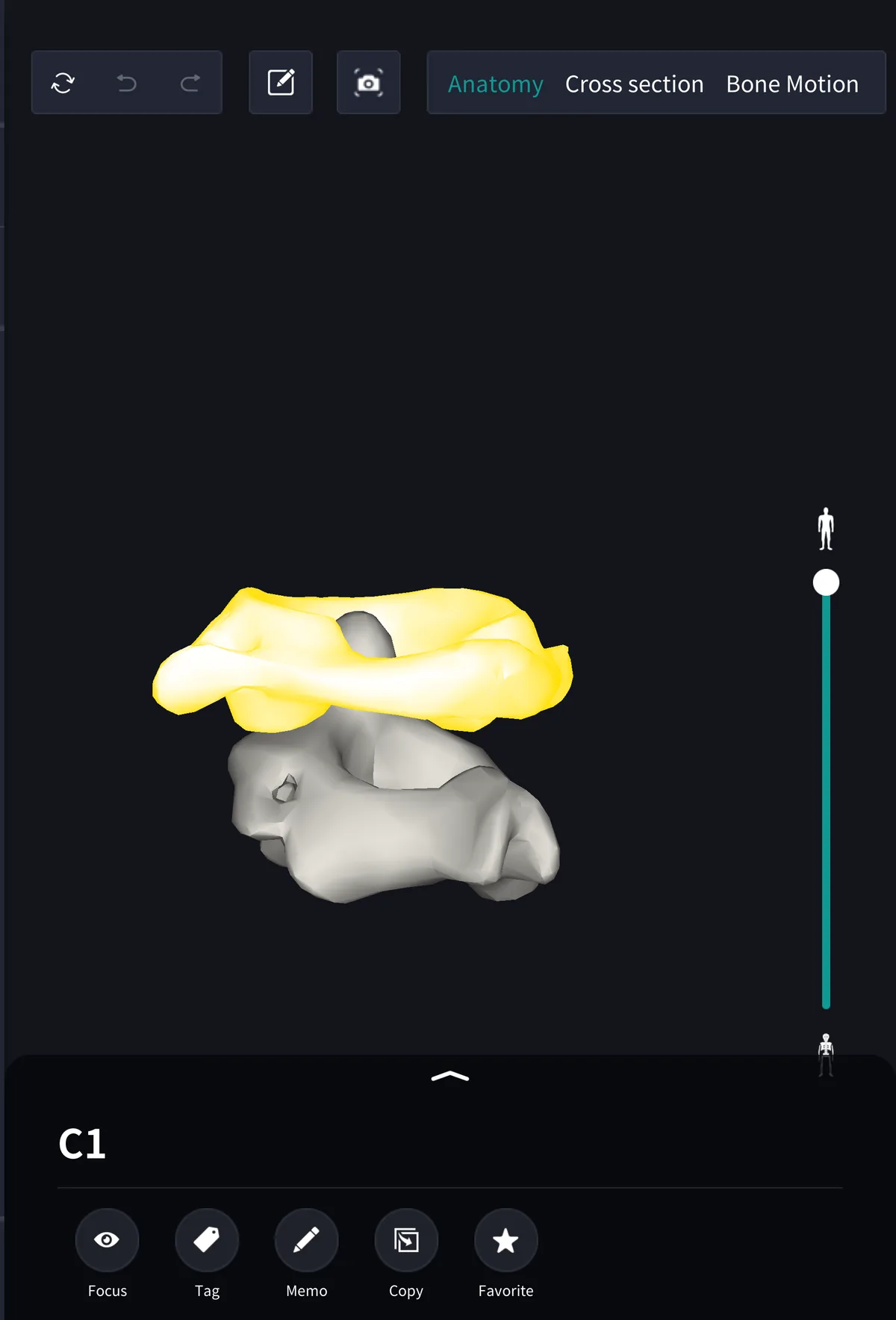
This view keeps only the atlas and the axis (C2) below it. A peg rising from the axis pokes up into the ring: the dens, the pivot the atlas turns around.
Two joints: occipital bone and axis
The upper joint is the atlanto-occipital joint. The upper facets of the lateral masses are oval hollows that hold the occipital condyles of the skull, and this is where most of the nodding movement happens.
The lower joint is the atlanto-axial joint, with three contacts: the two pairs of lateral facets and one between the anterior arch and the dens. The transverse ligament of the atlas holds the dens from behind, and the atlas and skull rotate around it together. Roughly half of side-to-side head rotation happens here; textbooks give a range of figures depending on how it is measured.
The gaps between the skull and the atlas are closed by the anterior atlanto-occipital membrane in front and the posterior atlanto-occipital membrane behind. The vertebral artery passes through the posterior membrane after running along the groove on the posterior arch.
Muscles attached to the atlas
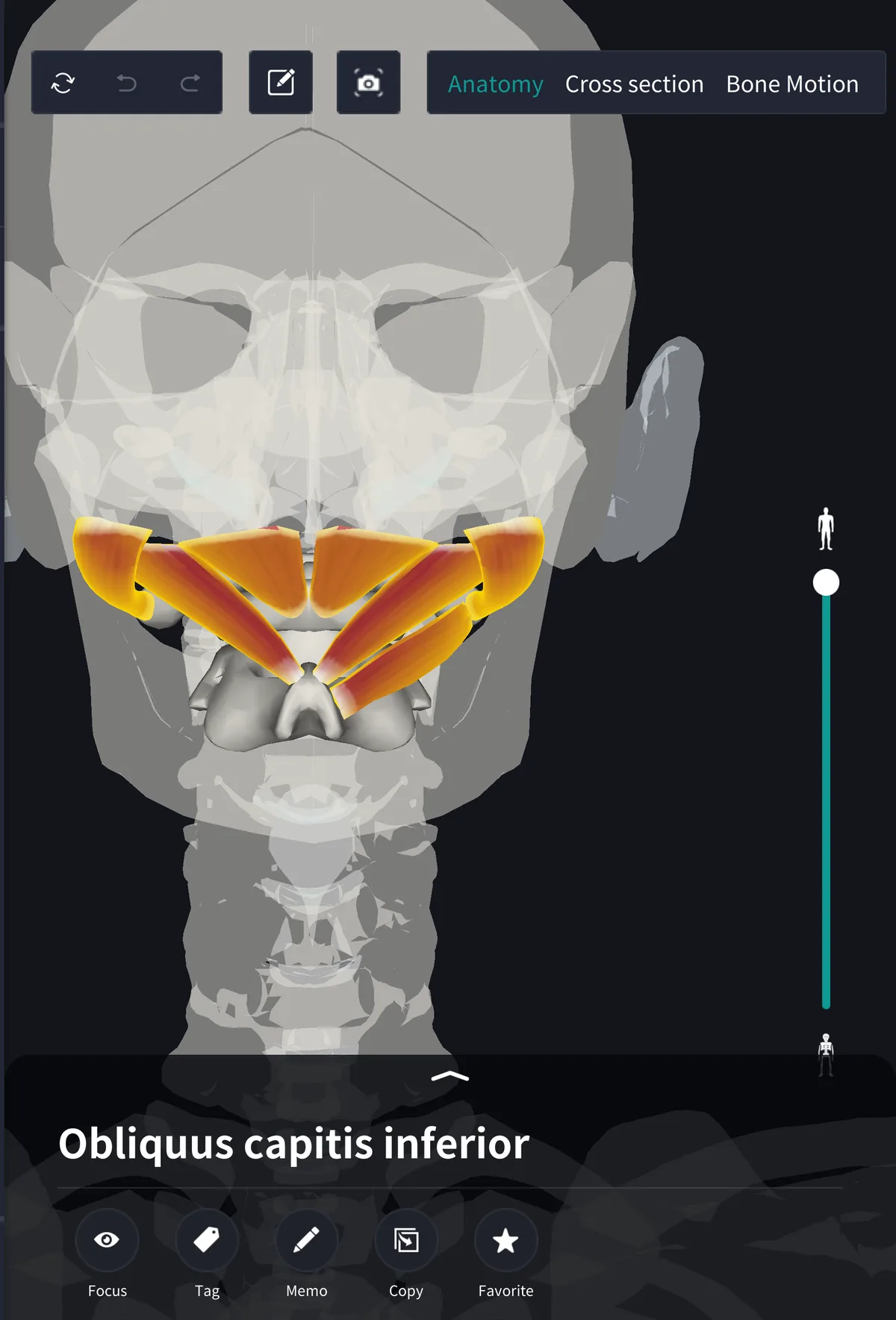
Four small suboccipital muscles lie on each side just below the skull, and three of them attach to the atlas:
・Obliquus capitis superior: from the transverse process of the atlas to the occipital bone
・Obliquus capitis inferior: from the spinous process of the axis to the transverse process of the atlas; the only suboccipital muscle that does not reach the skull
・Rectus capitis posterior minor: from the posterior tubercle of the atlas to the occipital bone
The fourth, the rectus capitis posterior major, runs from the axis past the atlas to the skull. In front, the rectus capitis anterior and lateralis run from the atlas to the occipital bone, and the levator scapulae arises from its transverse process.
Name and terms
The name comes from Atlas, the Titan of Greek myth who holds up the sky: the bone holds up the globe of the skull. The axis below is named for the pivot it provides. Related terms: dens, atlanto-occipital joint, atlanto-axial joint. The Latin is also atlas.
See it in the app
With the skull above and the axis below, the ring of the atlas is hard to see on a full skeleton. In the 3D anatomy app teamLabBody you can hide the other bones, keep just the atlas and axis, and rotate them to see where the dens enters the ring and how far the transverse processes reach out. Turn the muscles back on to see where the suboccipital muscles attach. Cross sections are available with the PREMIUM plan.
FAQ
- Are the atlas and C1 the same?
- Yes. The atlas is the first cervical vertebra, written C1. The second, C2, is the axis.
- How is the atlas different from other vertebrae?
- It has no body and no spinous process. It is a ring of anterior and posterior arches and two lateral masses, and the dens of the axis sits where a body would be.
- How do the atlas and axis move?
- The atlas and skull rotate together around the dens of the axis. Roughly half of side-to-side head rotation happens at this atlanto-axial joint.
Related articles
・Cervical vertebrae: the seven neck bones
・Transverse ligament of the atlas: holds the dens from behind
・Apical ligament of the dens: from the tip of the dens to the skull
・Rectus capitis posterior major and minor: the deep muscles below the skull
・Vertebral column: the number and order of the vertebrae