Where is the pubis? Pubic bone location, pubic symphysis, rami and attached muscles
Where is the pubis?
Slide a finger straight down from your navel. At the very bottom of the abdomen it stops against hard bone: that is the pubis. It forms the front, lower part of the bony ring of the pelvis, one on each side.
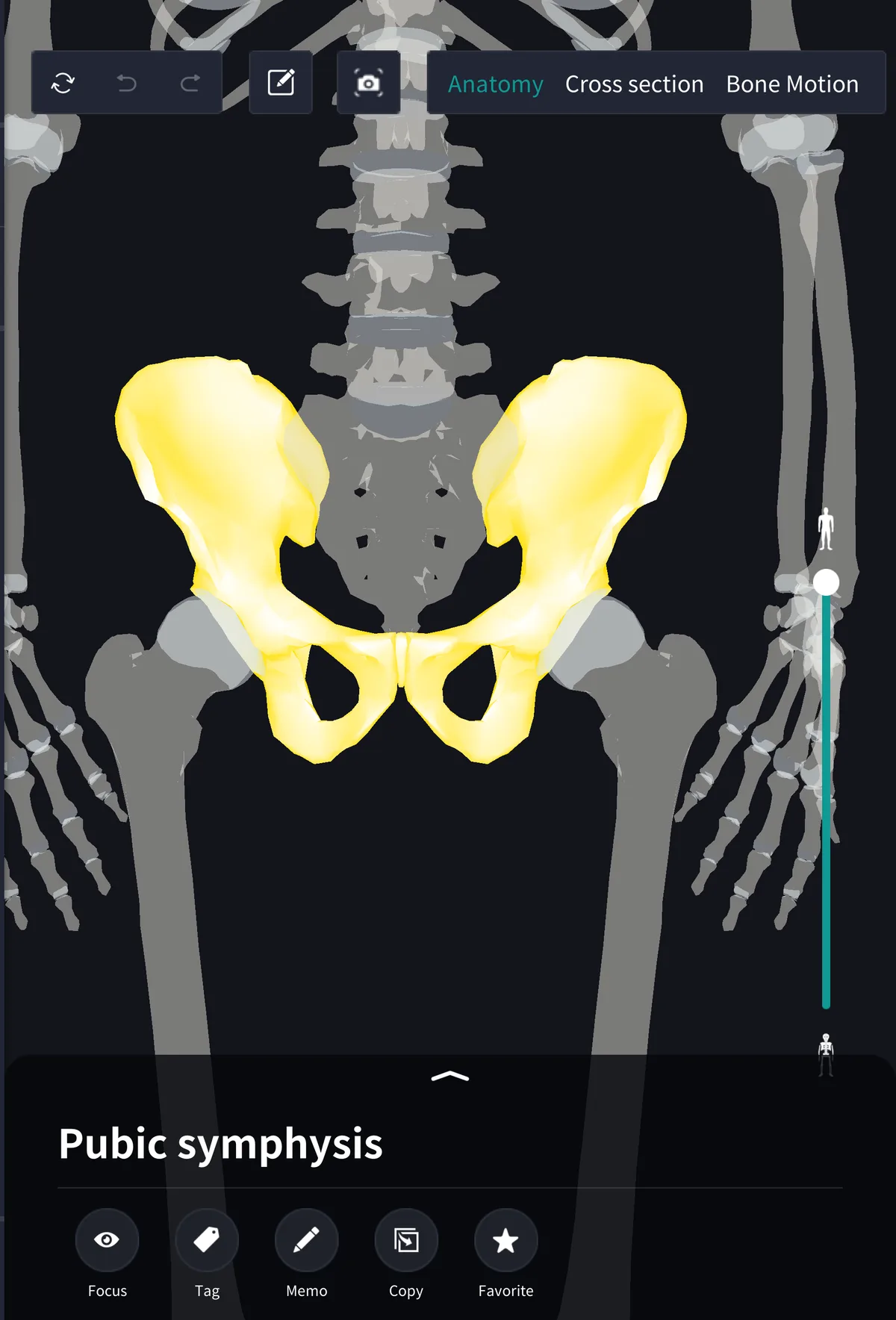
The horizontal edge under your finger is the pubic crest, and the midline joint where the two sides meet is the pubic symphysis. Follow the crest 2–3 cm outward and you reach a small bump, the pubic tubercle. The inguinal ligament runs to it from the anterior superior iliac spine of the ilium.
Hip bone, ilium and ischium
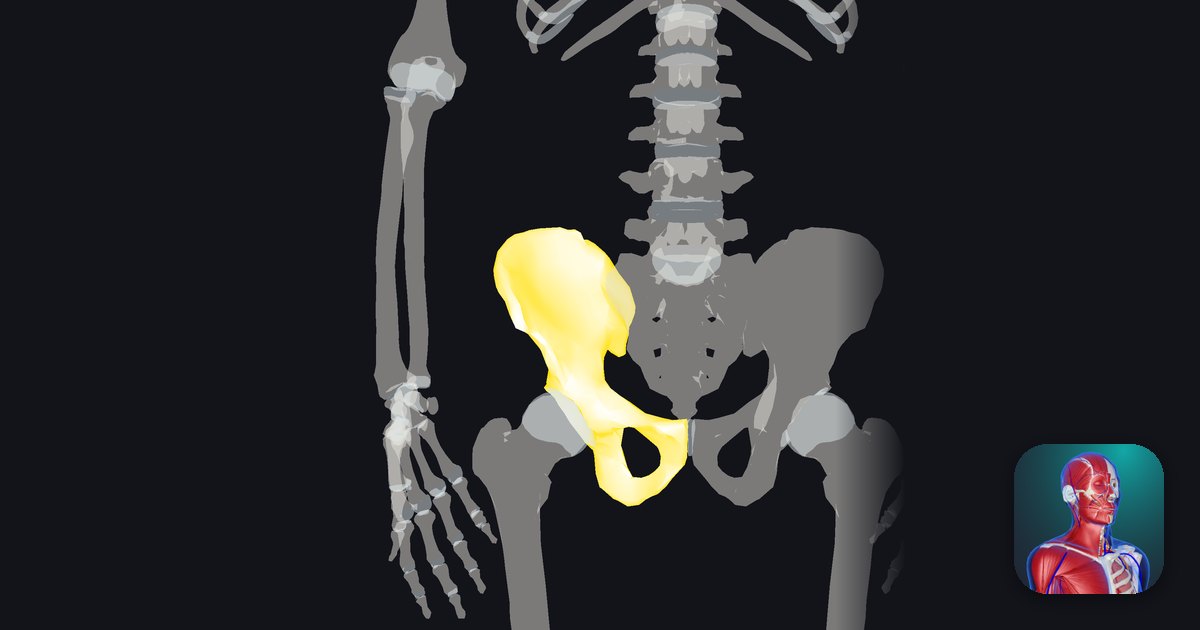
Each large side bone of the pelvis is the hip bone (coxal bone). It starts as three separate bones: the ilium above, the ischium behind and below, and the pubis in front and below. They meet at the hip socket (acetabulum) through a Y-shaped cartilage, which ossifies in the late teens and joins them into one bone.
In an adult skeleton the borders are invisible. The pubis forms roughly the front fifth of the acetabulum. In the app, too, the pubis is part of the hip bone: selecting the hip bone highlights ilium, ischium and pubis together.
Parts of the pubis
The thick body lies near the midline. From it the superior pubic ramus runs up and out to the acetabulum, and the inferior pubic ramus runs down and out to join the ramus of the ischium. Together the two lower rami form the thin ischiopubic ramus.
・Pubic crest: the upper edge of the body, the ridge you feel low on the abdomen
・Pubic tubercle: a small bump at the lateral end of the crest, where the inguinal ligament attaches
・Pecten pubis (pectineal line): a sharp edge along the top of the superior ramus, continuing into the arcuate line of the ilium as part of the pelvic brim
・Symphyseal surface: the inner face of the body, facing the opposite pubis
The large opening framed by the two rami and the ischium is the obturator foramen. A membrane closes most of it. A small gap at the top, the obturator canal, lets the obturator nerve and the obturator vessels pass from the pelvis to the thigh.
The pubic symphysis
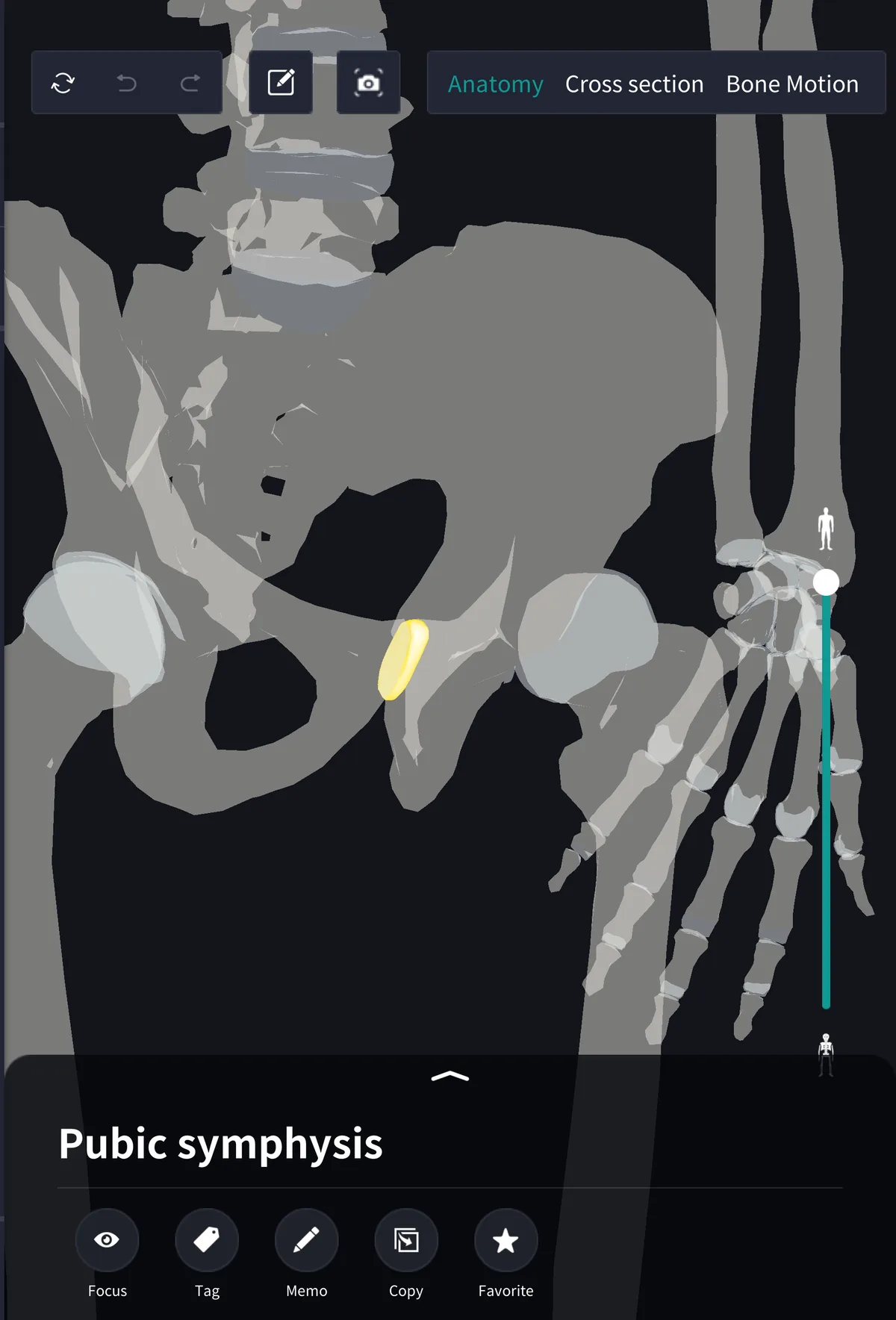
At the pubic symphysis the two symphyseal surfaces face each other with a fibrocartilaginous disc in between. The superior pubic ligament reinforces it above and the arcuate pubic ligament below. There is no joint cavity like in the shoulder or knee, and it barely moves.
Below the symphysis the two inferior rami form the subpubic angle. It is narrow in males, around 50–60°, and wider in females, around 80–90°, where it forms a rounded pubic arch. It is one of the first features checked when comparing male and female pelves, although individual variation is large and textbooks give slightly different ranges.
Muscles and ligaments attached to the pubis
Muscles reach the pubis from two directions. From above come the abdominal muscles: the rectus abdominis arises from the pubic crest and symphysis, and the small pyramidalis runs from the pubis to the linea alba.
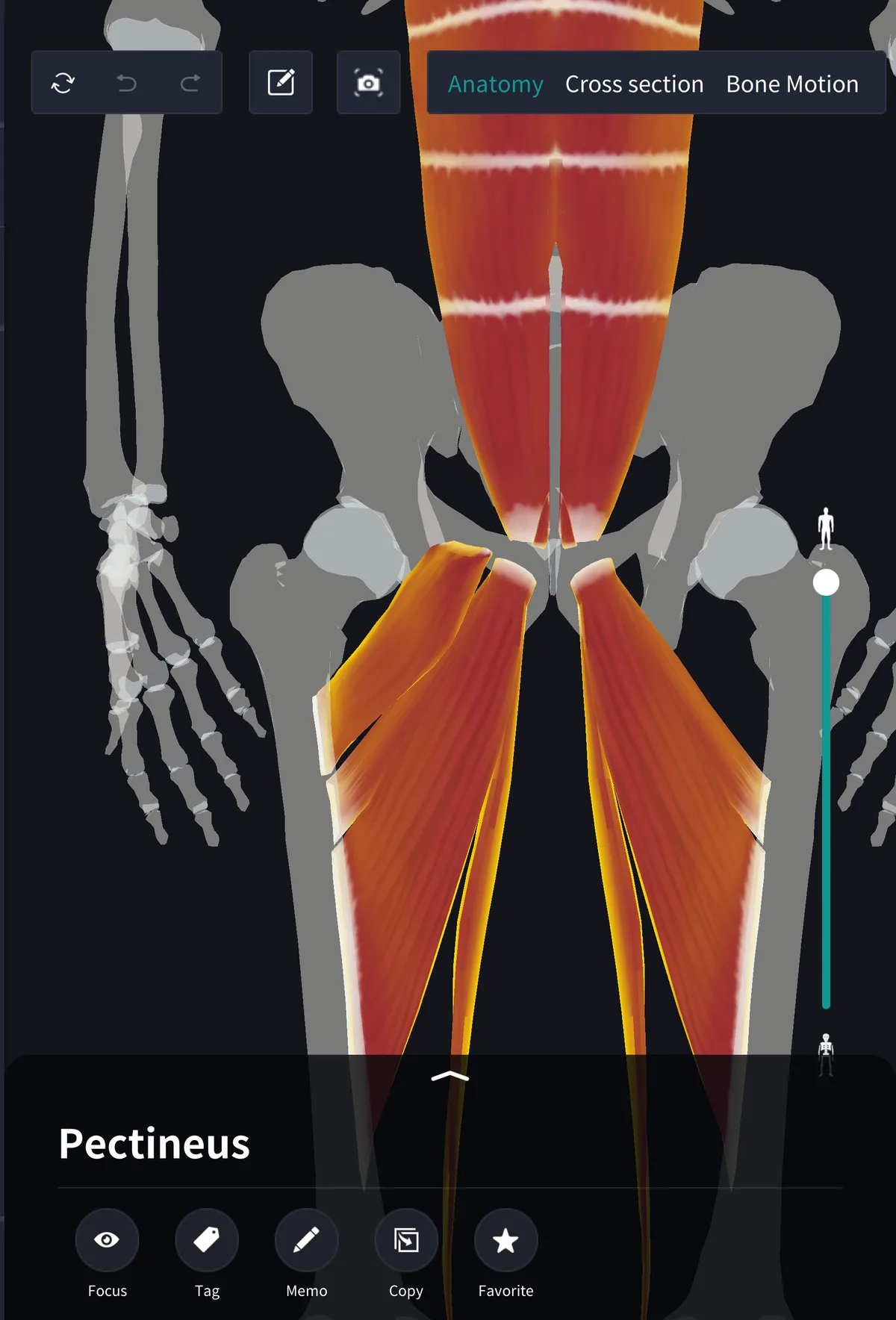
From below come the adductors of the thigh. The pectineus arises from the pecten pubis, the adductor longus from the front of the body, the adductor brevis and gracilis from the body and inferior ramus, and the adductor magnus from the inferior ramus back to the ischium. The muscles that bring the legs together are anchored here.
Inside the pelvis, parts of the levator ani (pubococcygeus and puborectalis) arise from the back of the pubis. The pubofemoral ligament runs from the superior ramus to the capsule of the hip joint and strengthens it from the front and below.
Name and terms
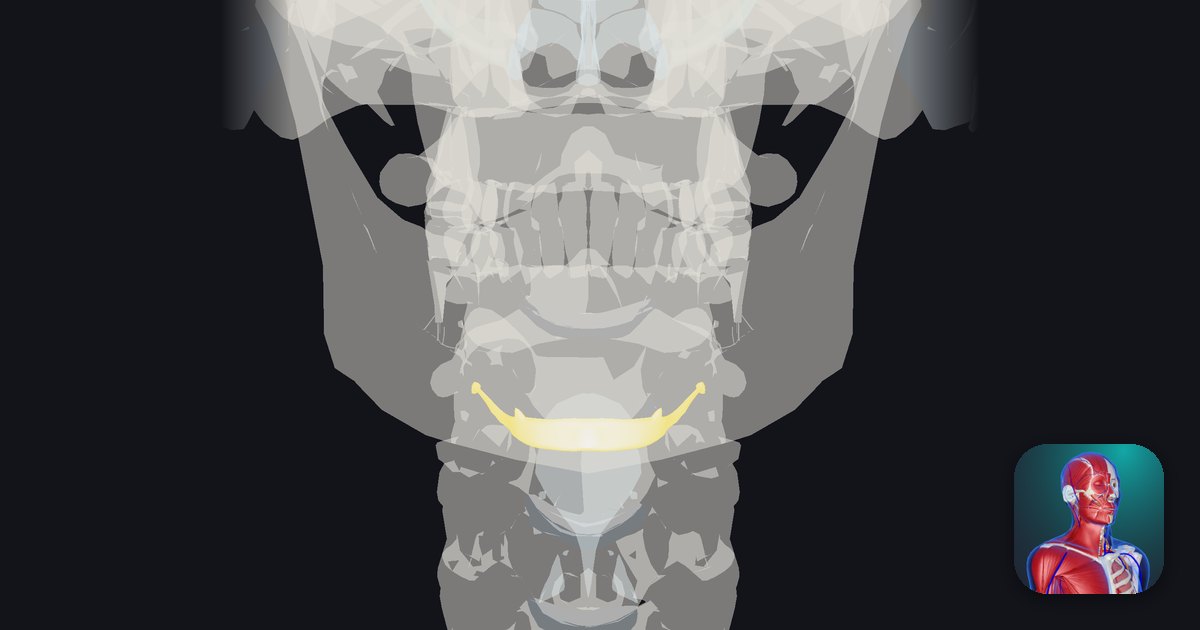
Pubis is pronounced PYOO-bis; the plural is pubes. It is also called the pubic bone, and the Latin is os pubis. Related terms: pubic symphysis, superior and inferior pubic rami, pubic tubercle, pubic crest and pecten pubis. The muscle name pectineus comes from the same Latin pecten, "comb".
See the pubis in the app
Textbook pelvis drawings are usually a single front view, which hides how the superior ramus curves back toward the acetabulum. In the 3D anatomy app teamLabBody you can rotate and zoom the pelvis to see the pubis and obturator foramen from the side or from below. The pubic symphysis is a separate part from the hip bone, so you can see exactly where the two sides meet. Turn the muscles back on to follow where the pectineus and adductor longus arise.
With the PREMIUM plan you can also use cross sections: a midline cut shows the pubic symphysis and the bladder behind it.
FAQ
- Where can I feel the pubis?
- Directly below the navel, at the very bottom of the abdomen. Your finger meets a horizontal hard edge, the pubic crest; its midpoint is the pubic symphysis. How easy it is to feel depends on the thickness of the overlying fat.
- What is the difference between the pubis and the pubic symphysis?
- The pubis is a bone, one on each side. The pubic symphysis is the joint where the two meet in the midline, with a fibrocartilaginous disc between them. It moves very little.
- How are the pubis, ischium and ilium related?
- All three are parts of the hip bone: the ilium above, the ischium behind and below, the pubis in front and below. They fuse at the acetabulum in the late teens.
- What is the pubis called in Latin and Japanese?
- Latin: os pubis. Japanese: 恥骨 (chikotsu). The pubic symphysis is symphysis pubica in Latin and 恥骨結合 in Japanese.
Related articles
・Ilium: the large upper part of the hip bone
・Ischium: the part of the hip bone you sit on
・Hip joint: the joint whose socket the superior pubic ramus helps form
・Adductor magnus: the large inner-thigh muscle from the pubis and ischium