Phrenic nerve: C3–C5 roots, course through the neck and chest, and function
Where does the phrenic nerve run?
The main muscle of breathing in is the diaphragm. It sits between the chest and abdomen, yet it is driven by a nerve that travels all the way down from the neck: the phrenic nerve.
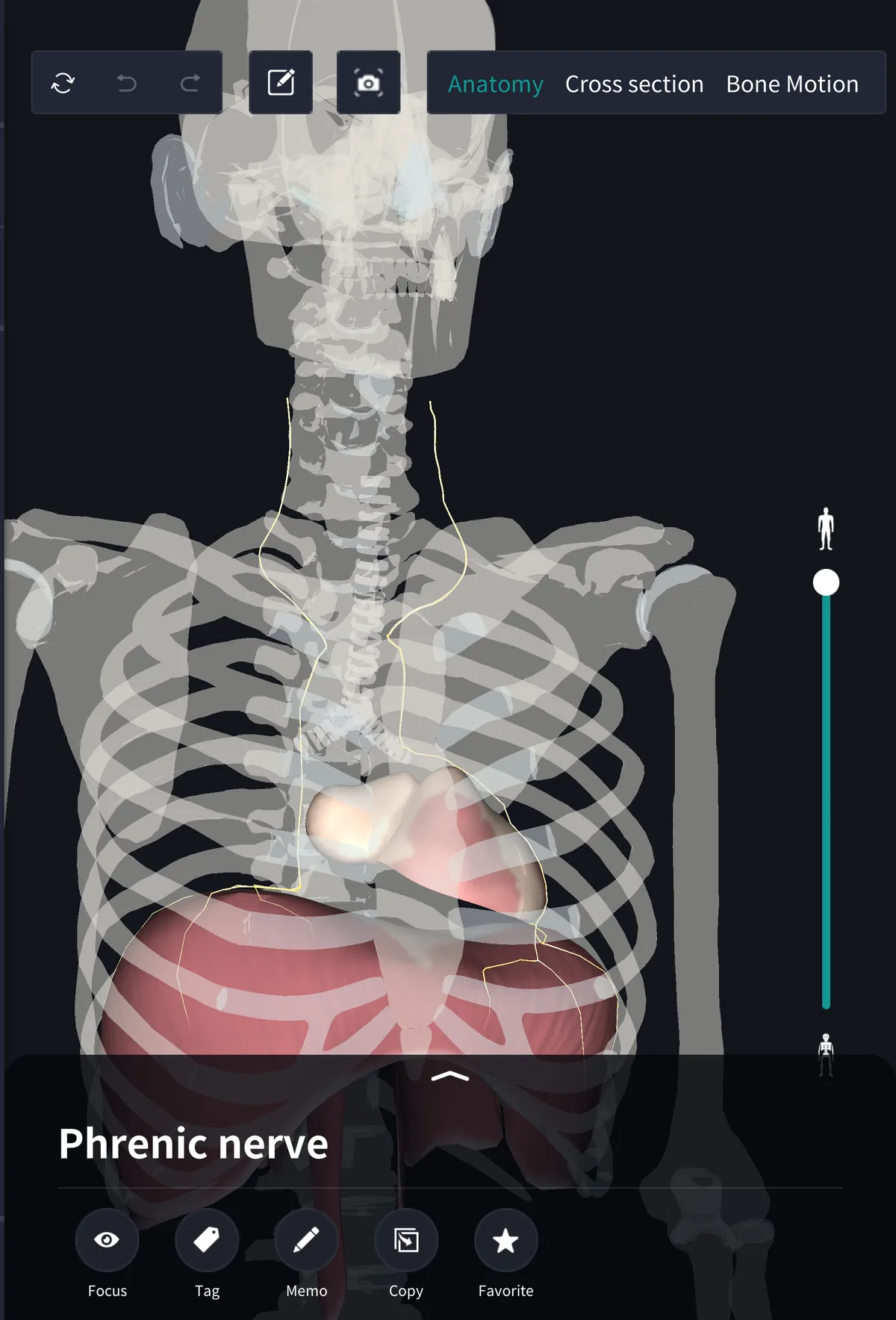
In the view above the thin yellow lines are the left and right phrenic nerves and the red dome is the diaphragm; the nerves pass close to either side of the heart. It comes from so high because the diaphragm begins to form at neck level in the embryo and then descends.
From the neck: C3–C5 and the anterior scalene
The phrenic nerve is a branch of the cervical plexus, with roots from C3, C4 and C5, mostly C4; hence the English mnemonic "C3, 4, 5 keeps the diaphragm alive". In the neck it runs obliquely down across the front of the anterior scalene from lateral to medial, then enters the chest between the subclavian artery and vein. Some C5 fibres may join by another route, such as the nerve to subclavius, as an accessory phrenic nerve, which is present in some people and not others.
In the chest: beside the pericardium
In the chest it passes in front of the root of the lung, between the fibrous pericardium and the mediastinal pleura; the vagus nerve passes behind the lung root instead.
・Right phrenic nerve: along the superior vena cava and right atrium, reaching the diaphragm near the inferior vena cava
・Left phrenic nerve: along the pericardium over the left ventricle, reaching the diaphragm near the apex of the heart
The routes differ because the heart lies left of the midline. Both pierce the diaphragm and branch on its undersurface.
Motor and sensory roles
The phrenic nerve is the only motor nerve to the diaphragm; each side supplies its own half. When the diaphragm contracts its dome descends and air flows in. It also carries sensation from the pericardium, mediastinal pleura, and the pleura and peritoneum over the central diaphragm; the periphery of the diaphragm is supplied by the lower intercostal nerves. Textbooks differ somewhat in how they draw these boundaries.
Name and terms
Phrenic comes from the Greek phren, which originally meant the diaphragm and, because the ancient Greeks placed the mind there, also came to mean mind. The Latin is nervus phrenicus.
See it in the app
Long and thin, the phrenic nerve is hard to follow in a single drawing. In the 3D anatomy app teamLabBody you can select it, make the bones translucent, and add only the heart and diaphragm to follow it continuously from the neck to the diaphragm. The part running on the diaphragm can be selected separately. Cross sections are available with the PREMIUM plan.
FAQ
- Where does the phrenic nerve come from?
- From the cervical plexus in the neck, with roots from C3 to C5, mostly C4.
- What is the course of the phrenic nerve?
- Down the front of the anterior scalene, into the chest between the subclavian artery and vein, in front of the lung root and beside the pericardium to the diaphragm.
- What does the phrenic nerve do?
- It is the only motor nerve of the diaphragm and also carries sensation from the pericardium, pleura and central diaphragm.
Related articles
・Diaphragm: the muscle it moves
・Scalenes: it descends on the anterior scalene
・Vagus nerve: runs behind the lung root
・Spinal nerves: including the cervical nerves
・Aorta: passes through the aortic hiatus of the diaphragm