Where is the submandibular gland? Location, mylohyoid relation and duct
Where is the submandibular gland?
Press gently up under the lower edge of your jaw, about halfway between the angle and the chin, and you will find a soft hollow tucked inside the bone. The submandibular gland lies there.
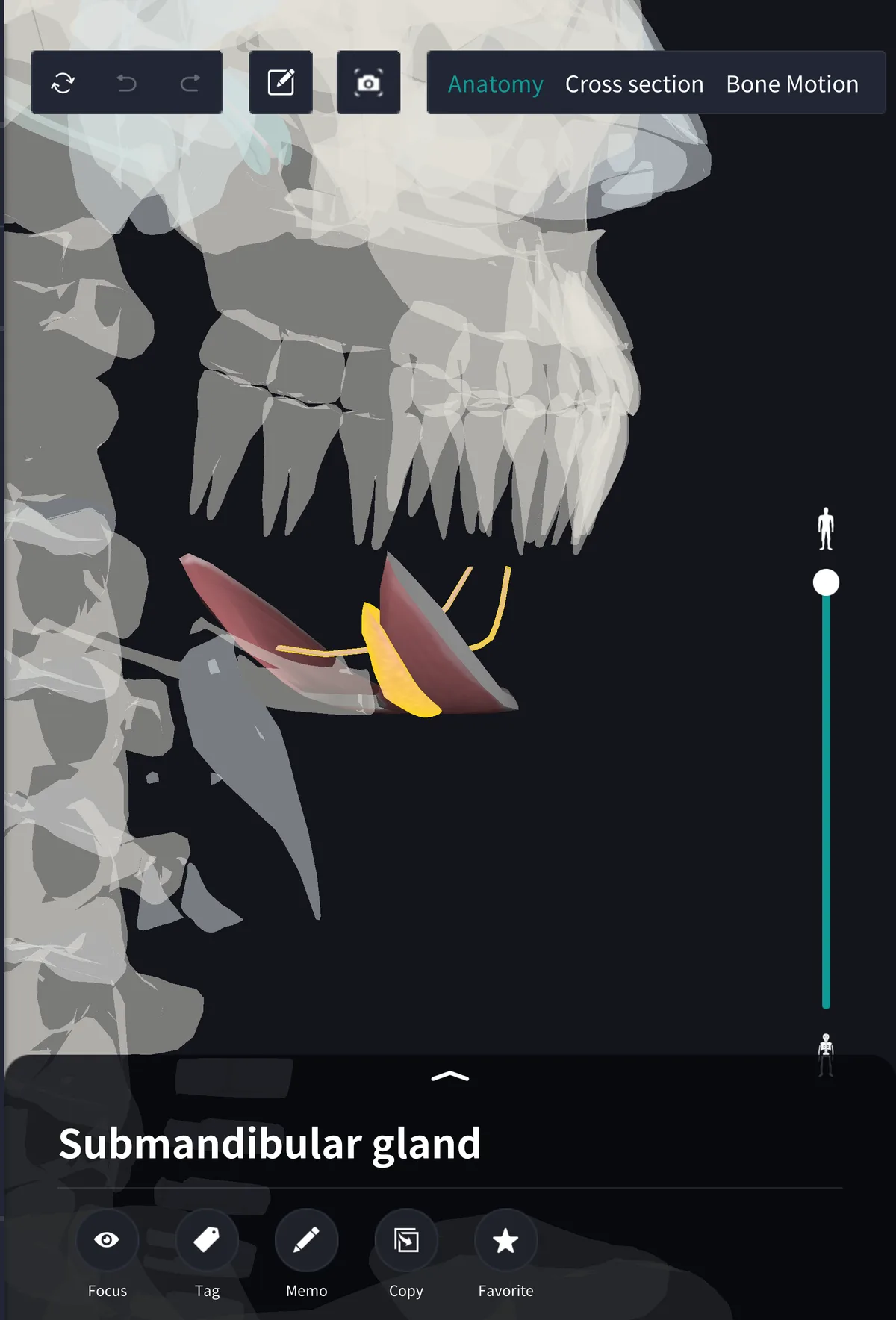
It sits on the inner side of the body of the mandible, in the submandibular (digastric) triangle bounded by the lower border of the mandible and the anterior and posterior bellies of the digastric. It is often compared to a walnut in size, but its shape and size vary between people.
The three major salivary glands
・Parotid gland: in front of and below the ear; the largest
・Submandibular gland: under the jaw, inside the mandible
・Sublingual gland: in the floor of the mouth under the tongue; the smallest
These are the major salivary glands, as opposed to the many minor glands scattered through the lips and cheeks. The parotid produces mainly watery (serous) saliva, the sublingual mainly mucous saliva, and the submandibular a mixture of both.
Superficial and deep parts around the mylohyoid
The key to the gland is its relation to the mylohyoid, the hammock-like sheet of muscle forming the floor of the mouth. The larger superficial part lies below the muscle, on the neck side. The smaller deep part curls around the free back edge of the muscle into the floor of the mouth above it. It is one U-shaped gland, not two separate ones.
The duct and the sublingual caruncle
The submandibular duct (Wharton's duct) leaves the deep part and runs forward about 5 cm in the floor of the mouth to open on the sublingual caruncle, a small papilla on each side of the frenulum under the tongue. The lingual nerve loops under the duct on its way. Secretion is driven by parasympathetic fibres of the chorda tympani, a branch of the facial nerve, which join the lingual nerve and relay in the submandibular ganglion.
Name and terms
Sub- means below and mandibular means of the mandible. The duct is the submandibular duct or Wharton's duct, after the anatomist who described it. The Latin is glandula submandibularis.
See it in the app
Overlapped by the mandible and the mylohyoid, the gland's two parts are hard to picture from flat drawings. In the 3D anatomy app teamLabBody you can select it, make the bones translucent, add only the mylohyoid, and rotate to see the gland wrap around the muscle and the duct run forward. Cross sections are available with the PREMIUM plan.
FAQ
- Where is the submandibular gland?
- Under the jaw on the inner side of the mandible, about halfway between the angle and the chin, in the submandibular triangle.
- Where does its saliva come out?
- Through the submandibular (Wharton's) duct, which opens on the sublingual caruncle beside the frenulum under the tongue.
- How is it different from the parotid and sublingual glands?
- All three are major salivary glands. The parotid is the largest and mainly serous, the sublingual the smallest and mainly mucous; the submandibular is in between in size and produces mixed saliva.
Related articles
・Submandibular duct: its course and relation to the lingual nerve
・Parotid gland: the largest salivary gland
・Sublingual ducts: the outlets of the sublingual gland
・Mylohyoid: the muscle between the superficial and deep parts
・Oral cavity: the tongue and salivary glands